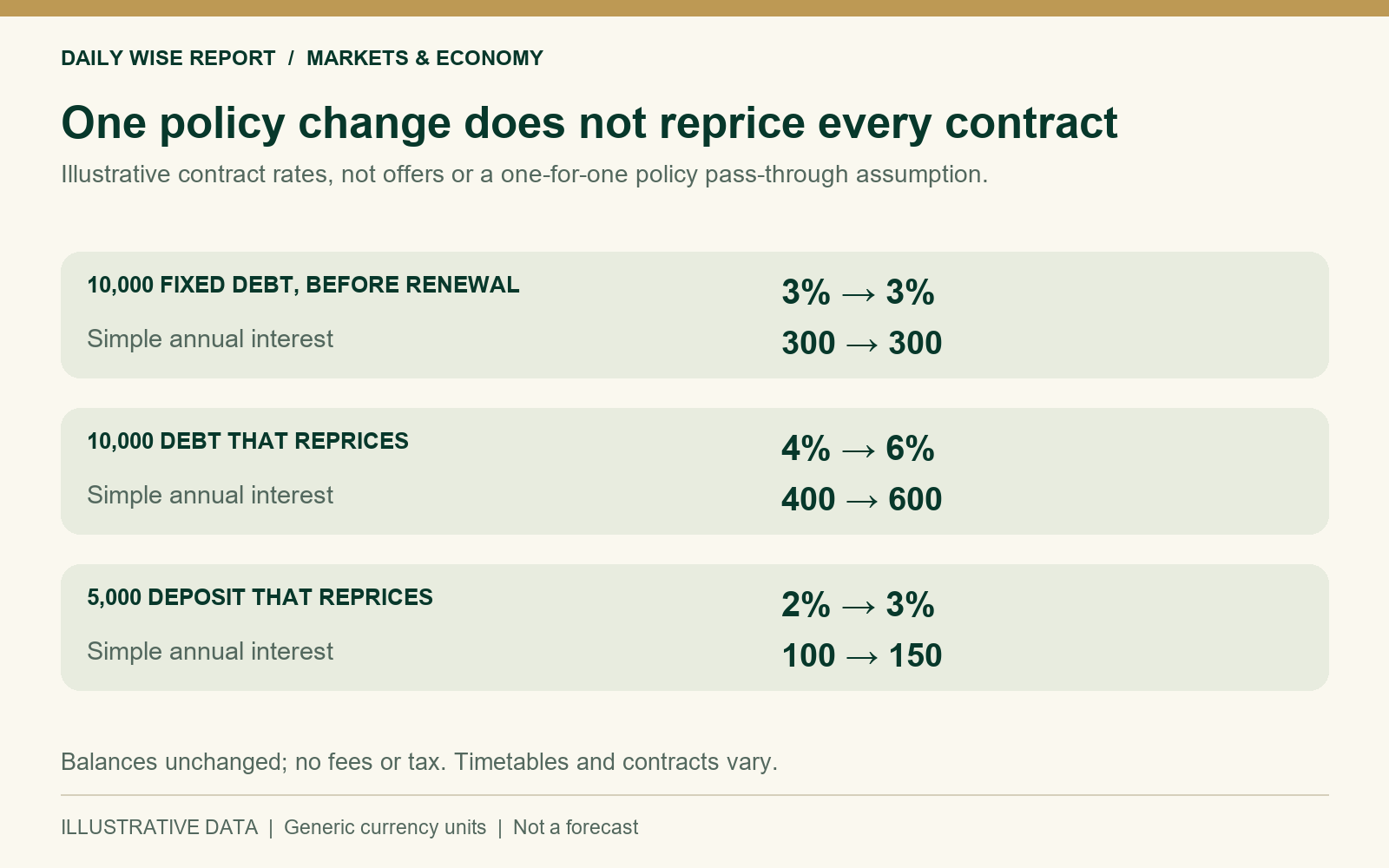
A home-loan quote can show a lower starting rate and still leave a household with a larger payment later. The difference between fixed and variable rates is about how interest is set over time. It affects payment certainty, exposure to market changes, and the range of outcomes a borrower may have to manage.
Mortgage terminology varies by country and lender. A variable loan may be called an adjustable-rate, floating-rate, tracker, or reset-rate mortgage. Some loans keep their rate fixed for the whole term. Others fix it for an introductory period, then switch to a variable formula. Reading the contract timeline matters as much as reading the first rate in an advertisement.
What a fixed rate fixes
With a fixed-rate loan, the interest rate is set for a stated period. If that period covers the entire loan term, changes in general market rates do not change the contractual rate on the outstanding balance. If a lender offers a rate fixed for only two, five, or another number of years, the loan can change after that period ends. It is fixed for a phase, not necessarily for the life of the mortgage.
Rate certainty makes the principal-and-interest portion easier to forecast. It does not guarantee that every amount on a mortgage bill will stay unchanged. Property taxes, homeowners insurance, service charges, or other local costs may be collected alongside the loan payment and can change separately. The billing arrangement also differs between countries and lenders.
How variable rates reset
A variable rate usually follows a reference rate, index, or lender-set formula. In a common structure, the rate after an introductory period is based on an index plus a margin specified in the contract. The index may move with market conditions. The margin is generally set for the loan, though exact terms depend on the agreement and local rules.
The contract also sets when adjustments happen. A rate may reset monthly, annually, or on another schedule. Some loans have an initial fixed period followed by regular adjustments. Others are variable from the start. A cap may limit how much the rate can rise at one reset or over the life of the loan. A floor can set the lowest rate. Caps, floors, and reset dates can make two loans with the same initial rate behave quite differently.
When an adjustable rate changes, the lender may recalculate the payment to repay the remaining balance over the remaining term. In that standard arrangement, a higher rate generally raises the required principal-and-interest payment. If the payment does not rise enough to cover the interest due, the balance may decline more slowly or, under some contract designs, increase. The loan documents determine which outcome applies.
Why the lower starting rate can be misleading
Introductory rates can make variable-rate loans look less expensive at first. That early difference is real, but it covers only the initial period. Once the rate resets, the index, margin, timing, and caps determine the result. If market rates rise, the payment may rise as well. If rates fall, some variable payments can fall, subject to floors and contract rules.
A fixed-rate offer may begin at a higher rate because it transfers some interest-rate uncertainty away from the borrower. Pricing also reflects lender funding costs, competition, fees, and other terms. No rate type is always cheaper over the full loan life. The total cost depends on the starting balance, schedule, fees, how rates move, and how long the borrower keeps the loan.
A simple way to compare the risks
Consider two otherwise similar loans. One keeps the rate fixed for the full term. The other begins with a lower rate, then resets every year. At first, the second loan may require a smaller principal-and-interest payment. If its index rises before the borrower repays or refinances, the reset formula could increase the rate and payment. If the index falls, the payment may stay lower, though any floor or cap affects how much it can move.
This comparison is a scenario, not a forecast. It shows why the starting payment alone cannot settle the question. A useful comparison includes the payment at the initial rate, the payment under the contract’s maximum permitted rate, and the amount of fees needed to obtain each rate. Lenders in some jurisdictions provide standardized disclosure examples; the format and legal requirements are not the same everywhere.
What to check in the loan terms
Start with the date the first adjustment can occur and the frequency of later resets. Find the index, the margin, and the formula that converts them into the new rate. Check the cap on the first adjustment, the cap at each later reset, the lifetime cap, and any floor. A low initial payment is harder to assess without knowing the largest payment the contract could permit.
Then check how the loan handles principal. Does each payment cover interest and reduce the balance? Is there an interest-only period? Can a payment be smaller than the interest due? Does the contract include a large final payment? A loan that postpones principal repayment can make early payments look manageable while leaving a larger balance or a later payment change.
Review fees and exit terms too. Discount points or arrangement fees may lower an initial rate but raise the cash needed at closing. An early repayment charge or refinancing fee can make it costly to switch. A borrower may plan to sell or refinance before a reset, but a home’s value, household income, credit conditions, and available loan offers can change. A future refinance is not guaranteed.
Rate changes are only one source of payment changes
Some borrowers see a mortgage bill change and assume the interest rate changed. The bill can include other charges. In the United States, for example, an escrow account may collect property tax and insurance amounts with the mortgage payment; changes in those costs can alter the total bill even when the mortgage rate is fixed. Temporary rate buydowns, interest-only periods ending, and mortgage insurance changes can also affect payment amounts.
That is why the statement and the loan agreement should be read together. Separate principal and interest from taxes, insurance, fees, and any temporary payment arrangement. The same general practice applies elsewhere, although mortgage statements and consumer protections are governed by local law.
How the trade-off changes for different households
A fixed rate reduces one kind of uncertainty: changes in market interest rates. A variable rate exposes the borrower to those changes in exchange for a contract that may have a lower starting rate or another feature. A household with little room in its monthly budget may experience a payment increase differently from one with substantial cash reserves. Income stability, expected time in the home, other debts, and local loan rules also affect how the contract fits a situation.
These considerations do not produce one universally suitable rate type. They describe the risks carried by each contract. The official guidance from the U.S. Consumer Financial Protection Bureau, for example, urges borrowers considering an adjustable-rate mortgage to understand how high the payment could go and whether that amount would remain affordable. The agency’s rules apply to the United States; borrowers elsewhere should use their own regulator’s disclosures and protections.
Sources and further reading
- Consumer Financial Protection Bureau: Fixed-rate and adjustable-rate mortgage differences
- Consumer Financial Protection Bureau: What to check in an adjustable-rate mortgage
- Consumer Financial Protection Bureau: Why a mortgage payment can change
This article explains loan mechanics for general education. Mortgage terms, disclosures, fees, and borrower protections vary by country and contract; it is not a recommendation to choose a particular loan.
Leave a Reply