
Banking & Credit
How accounts, payments, and borrowing work—and where costs and risks arise.
Banking & Credit, in depth.
 Analysis
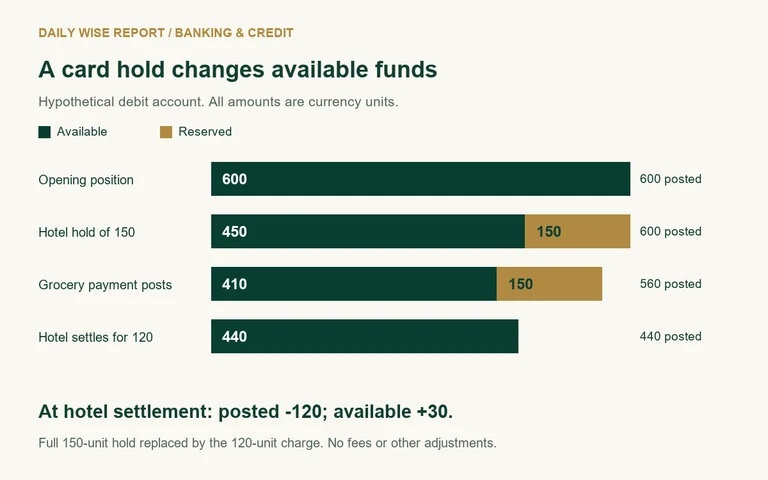
How a pending card payment changes your available balance
A card reservation can reduce the money available for another payment before the final charge posts. The order of events explains why the figures move differently.
Read full article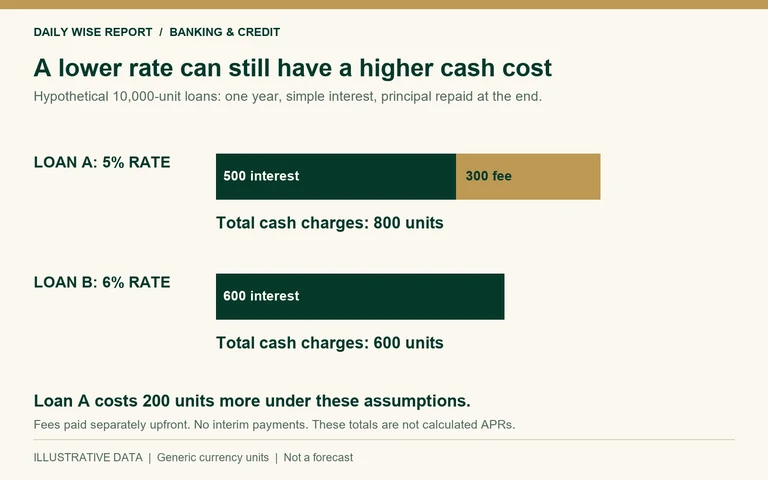 Analysis
Why a Lower Loan Rate Can Still Mean a Higher Borrowing Cost
Upfront charges, the amount actually received and the repayment schedule can alter what a headline interest rate appears to promise.
Read full article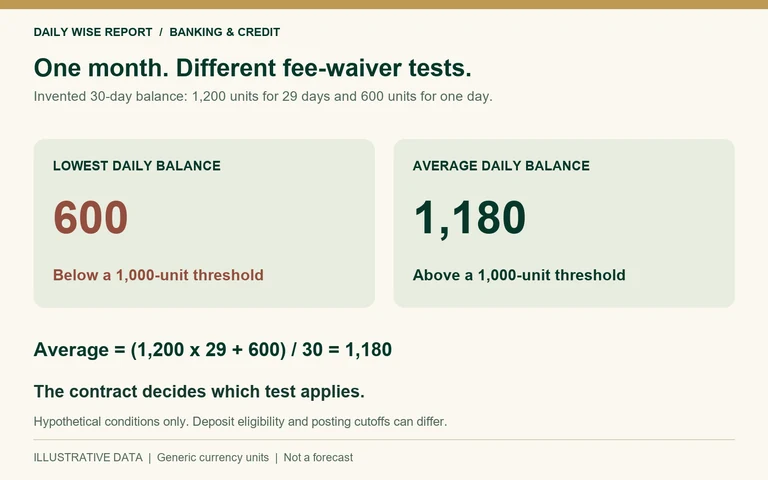 Analysis
Why a Bank Account Fee Waiver Can Disappear from One Month to the Next
A minimum-balance rule can depend on the lowest day, the monthly average or qualifying deposits. Those measures can produce different results.
Read full article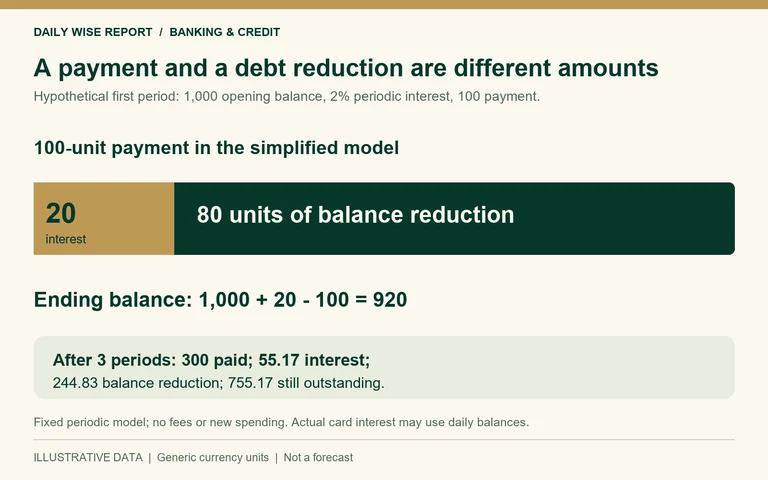 Analysis
Why a Credit Card Payment Does Not Reduce Debt by the Same Amount
Part of a payment may cover interest or fees before the principal falls. New spending can offset the reduction altogether.
Read full article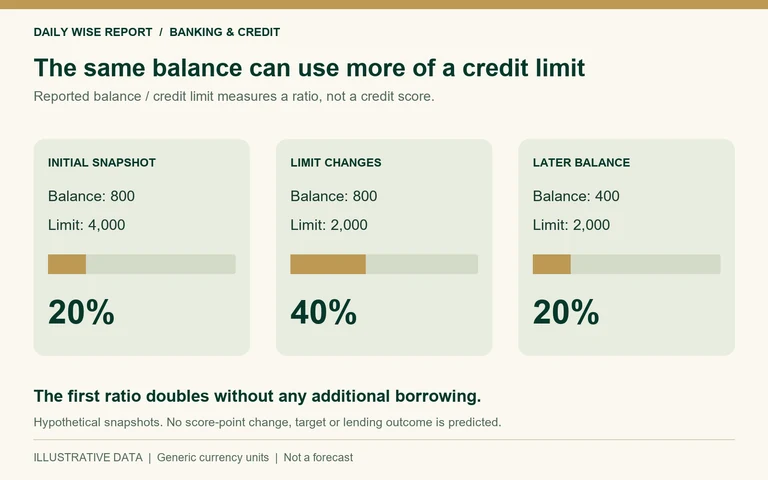 Analysis
A Credit Score Is a Snapshot, Not a Complete Financial Portrait
Reported balances, credit limits, model choice and timing can change a score without describing every part of a household’s finances.
Read full article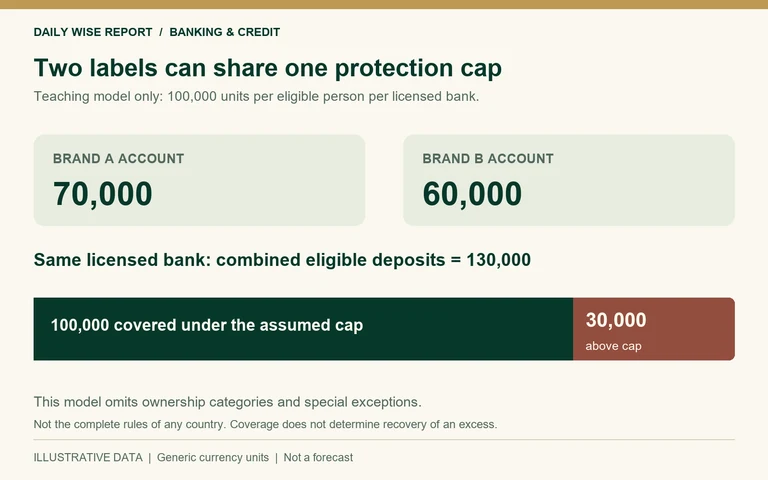 Analysis
Deposit Protection: Why the Bank Behind the Brand Matters
Several accounts can share one protection limit. Eligibility, the licensed institution and the ownership arrangement shape the result.
Read full articleThe mechanics behind your money.
Explore account charges, payment timing, borrowing costs, and repayment structures. Rules and protections vary by country and product.
Accounts & Fees
What an account costs beyond its headline price.
Explore concept ↓02Balances & Payment Timing
Why displayed balances and available funds can differ.
Explore concept ↓03Interest Rates & APR
Why two percentages can describe different costs.
Explore concept ↓04Repayment & Amortization
How a payment is divided between principal and interest.
Explore concept ↓Accounts & Fees
Account costs can include recurring charges and fees triggered by particular transactions or conditions. A monthly fee describes only one part of the price.
How it works
In a hypothetical account, a monthly charge of 5 currency units amounts to 60 over a year. Transfer, ATM, or currency-conversion charges would add to that total if they apply. This example describes arithmetic, not a real account offer.
Negative effects & limitations
Repeated fees can place a larger proportional burden on small balances. Fee waivers may depend on conditions, and an account described as free may still have transaction-related charges. Terms and local advertising rules differ.
Balances & Payment Timing
A recorded balance and the amount available for spending may differ because of pending transactions, holds, or deposits that are not yet available.
How it works
Authorization and final posting do not necessarily occur at the same moment. The sequence of deposits and withdrawals can therefore change the funds available when a payment is processed.
Negative effects & limitations
Timing differences can lead to declined payments or overdrafts, depending on the account. Fees and overdraft permissions are governed by product terms and local rules; US consent rules are not global rules.
Interest Rates & APR
An interest rate describes interest charged on borrowed principal. Annual Percentage Rate (APR) is an annualized measure that can include certain additional borrowing charges under the applicable calculation rules.
How it works
An origination fee can make a loan’s APR higher than its stated interest rate. Which charges are included, and the assumptions used, depend on the product and jurisdiction.
Negative effects & limitations
APR does not by itself show every possible future charge or the total amount paid. Variable rates, contingent fees, and different repayment periods complicate comparisons. US auto-loan disclosures are one specific context, not a worldwide standard.
Repayment & Amortization
In a standard fully amortizing fixed-rate loan, scheduled payments cover interest and reduce principal until the balance is repaid. With equal payments, the interest share usually falls as principal declines.
How it works
For 10,000 currency units borrowed at 8% annually with monthly amortization, a three-year term gives a payment of about 313.36 and total interest of about 1,281.09. A five-year term gives about 202.76 and 2,165.84. These are hypothetical calculations with no fees and an unchanged rate.
Negative effects & limitations
The longer term lowers the monthly payment in this example but increases total interest and extends the obligation. Interest-only, balloon-payment, variable-rate, and precomputed-interest loans can behave differently.
Sources & scope
The linked CFPB materials describe US banking and lending contexts. General mechanisms are explained here, while legal requirements, APR calculations, overdraft permissions, and fee rules are not assumed to apply worldwide.
All numerical examples are hypothetical, use generic currency units, and are not product offers. Monthly loan payments use the annual rate divided by 12, fixed payments, and no fees; figures are rounded.
Reviewed October 14, 2026. This page provides educational analysis, not product recommendations or individual borrowing advice.
Explain the mechanism
Separate account features and loan structures from headline claims.
Examine negative effects
Account for costs, timing pressures, and longer obligations.
State the limits
Identify assumptions and country-specific rules.