Deposit Protection: Why the Bank Behind the Brand Matters
Several accounts can share one protection limit. Eligibility, the licensed institution and the ownership arrangement shape the result.
Two banking apps can place deposits with the same underlying bank. Conversely, a corporate group can contain several separately licensed banks. The relevant protection scheme determines how the deposits are grouped for coverage.
How the named schemes define coverage
As checked on October 16, 2026, the US FDIC states a standard limit of $250,000 per depositor, per insured bank, for each ownership category. The UK’s FSCS states £120,000 per eligible person, per authorised firm, effective December 1, 2025. The European Banking Authority describes the EU’s harmonised level as €100,000 or its local-currency equivalent.
These are jurisdiction-specific summaries with conditions and exceptions, not interchangeable global limits. The currencies differ too: the headline numbers cannot establish equal coverage in purchasing-power terms.
Aggregation changes the apparent total
Our imaginary scheme has a 100,000-unit cap per eligible person per licensed bank. It has no extra ownership categories or temporary-balance exceptions. This teaching model does not reproduce the complete rules of any named jurisdiction.
| Item | Amount |
|---|---|
| Brand A account | 70,000 |
| Brand B account | 60,000 |
| Combined eligible deposits | 130,000 |
| Covered under assumed cap | 100,000 |
| Above assumed cap | 30,000 |
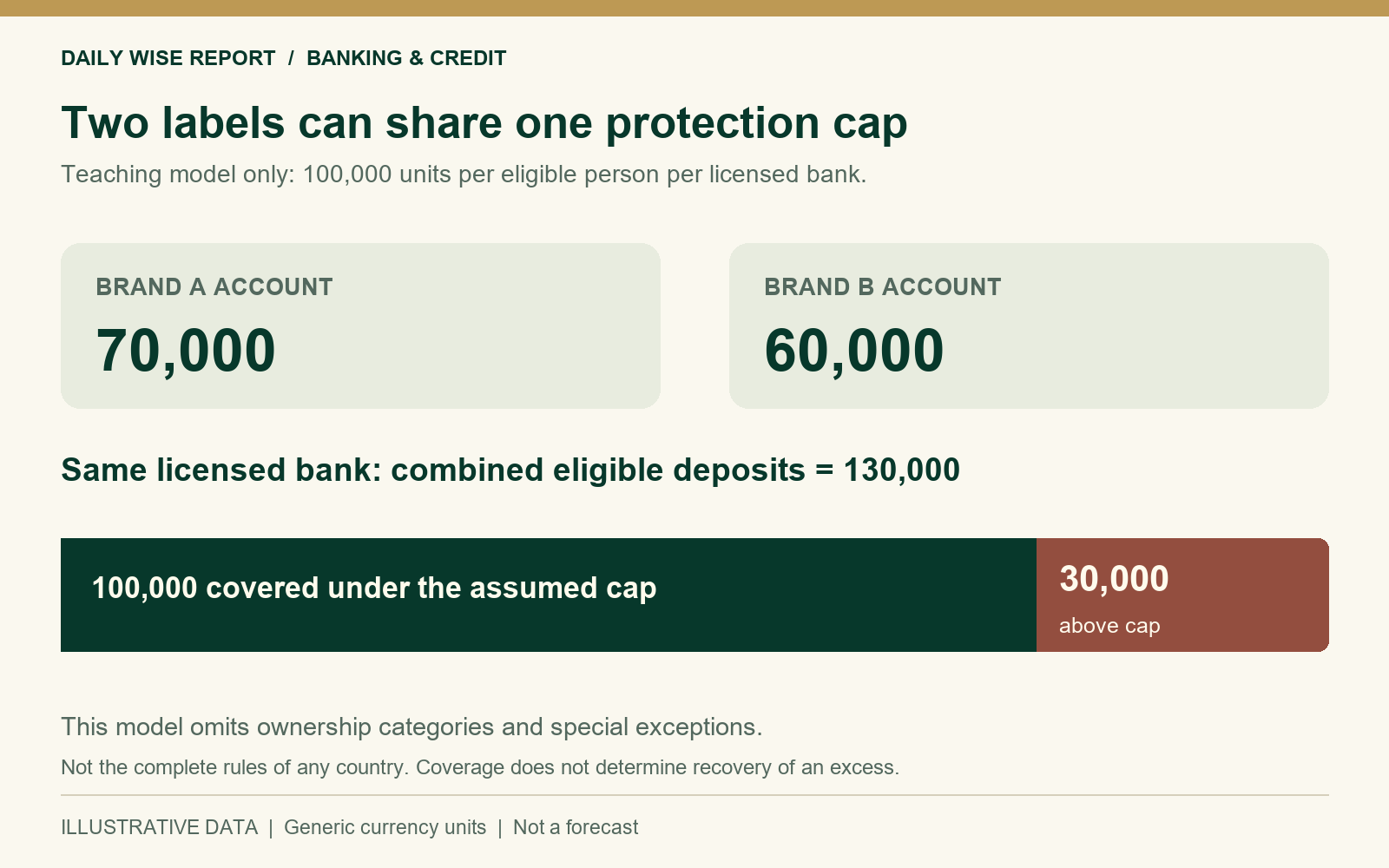
The two brands share the same bank in this model, so their deposits are combined before the cap is applied. Applying it to each brand separately would overstate coverage of the 130,000 units. A different ownership structure or scheme could give another result.
Protection does not address every kind of loss
Deposit insurance covers defined bank-failure events and eligible deposits. It does not turn every product displayed in a banking app into a protected deposit. The FDIC, for example, distinguishes insured deposits from non-deposit investments such as stocks and mutual funds.
Fraud, an investment price decline, a payment dispute and a bank failure involve different mechanisms. A protection logo does not explain how a specific loss will be treated. Nor does a guarantee establish that an account will be accessible at every moment during an operational disruption.
An uncovered amount is not a recovery estimate
The 30,000 above the assumed cap is outside the guarantee. The eventual loss and any insolvency recovery depend on what happens afterward, including when and how much can be recovered.
Intermediated funds, joint holdings and unusually large temporary balances can require separate treatment. An app’s branding alone cannot establish the identity of the protected depositor, the status of the bank or whether the product is eligible.
Scope and limitations
Rules can change. The linked scheme materials support the dated examples, not a coverage determination for any reader’s account. No institution selection or deposit allocation is recommended.
Related reading
A Credit Score Is a Snapshot, Not a Complete Financial Portrait
Leave a Reply