A Credit Score Is a Snapshot, Not a Complete Financial Portrait
Reported balances, credit limits, model choice and timing can change a score without describing every part of a household’s finances.
A credit score summarizes selected information used in a lending system. It leaves out the full transaction history, the reasons behind a balance and some resources available for repayment. That limits what the number can say about someone’s finances.
A report and a score are different outputs
The US Consumer Financial Protection Bureau explains that scores are generally based on credit-report information and that consumers can have more than one score. Models and available data can differ. This describes the US context; countries have different reporting arrangements and lender practices.
A report contains records; a model interprets selected features of those records. A lender may use additional information and its own criteria. An isolated score therefore cannot establish guaranteed approval or a particular interest rate.
The same balance can produce a different ratio
One observable relationship is a reported revolving balance divided by its credit limit. The following arithmetic illustrates that ratio. It does not calculate score points or reproduce a scoring model.
| Snapshot | Reported balance | Credit limit | Balance ÷ limit |
|---|---|---|---|
| Initial | 800 | 4,000 | 20% |
| Limit changes; same balance | 800 | 2,000 | 40% |
| Later balance is lower | 400 | 2,000 | 20% |
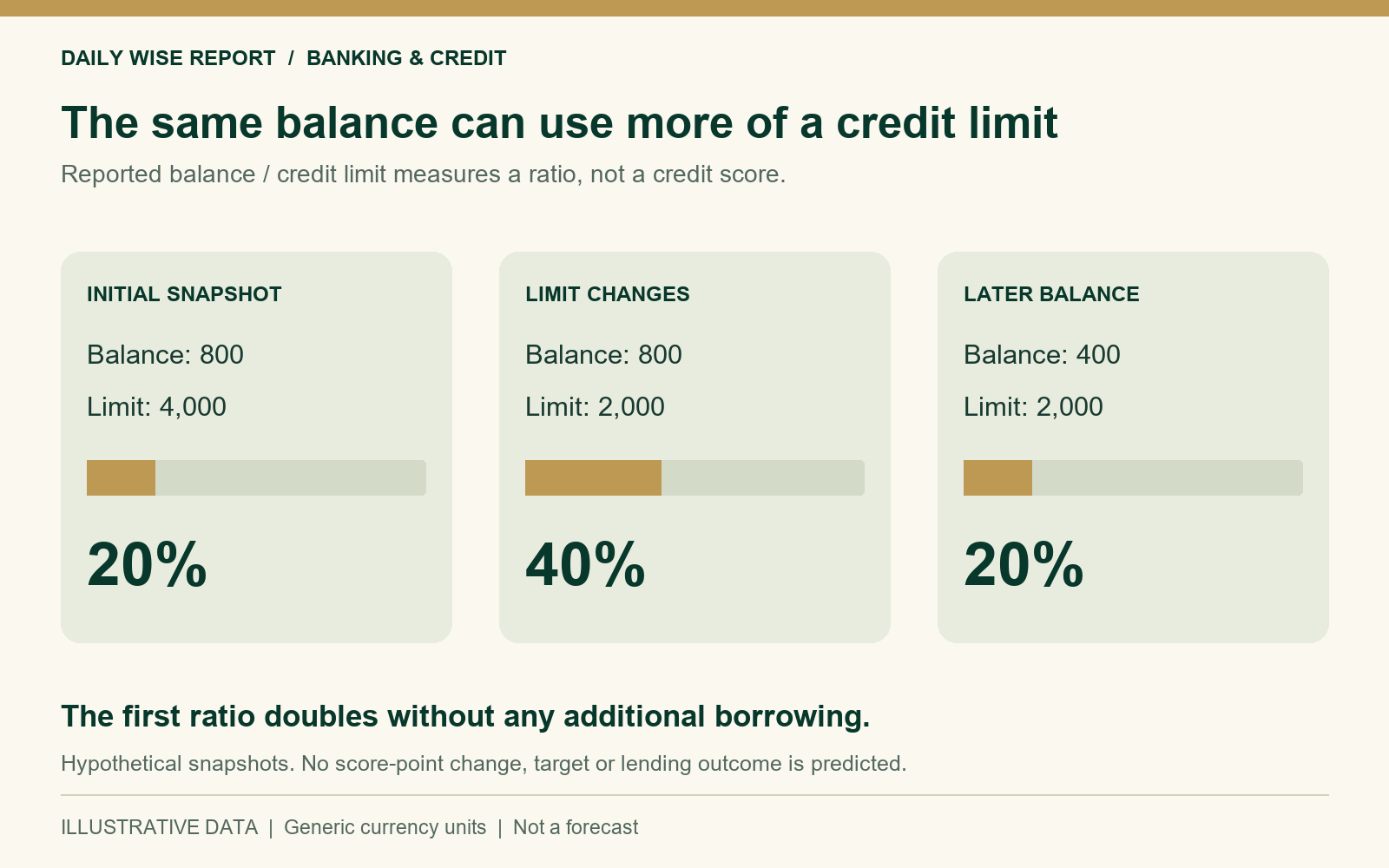
Halving the limit doubles the ratio without new borrowing. Later, a balance of 400 against a 2,000 limit returns the ratio to 20%, though both amounts differ from the first snapshot.
Reporting time differs from payment time
The CFPB’s explanation of balance timing notes that a score can reflect a high balance when calculated even if the balance is paid the next day. A reported snapshot and an eventual payment are separate observations.
Suppose a lender reports 800 on day 20 and receives payment on day 21. The day-20 record can show 800 while the current balance is zero. Different measurement dates can explain that difference without an error; the dates here are invented.
What the number leaves unresolved
A high score does not establish the availability of emergency cash or the affordability of another monthly payment. A lower score does not explain whether a particular record reflects an error, an old disruption or current financial pressure.
Incorrect records can distort model inputs, while accurate records can still be interpreted differently by different models. Predicting that one payment will add a fixed number of points would exceed the evidence available in this example. The table is also silent about income, expenses and assets.
Scope and limitations
These ratios are examples, not thresholds or targets. No account-opening, borrowing or credit-repair strategy is prescribed. This article makes no claim that a score or credit history transfers unchanged between countries.
Related reading
Why a Lower Loan Rate Can Still Mean a Higher Borrowing Cost
Leave a Reply