
Digital Life
Connected services. Real costs and consequences.
Digital Life, in depth.
 Analysis
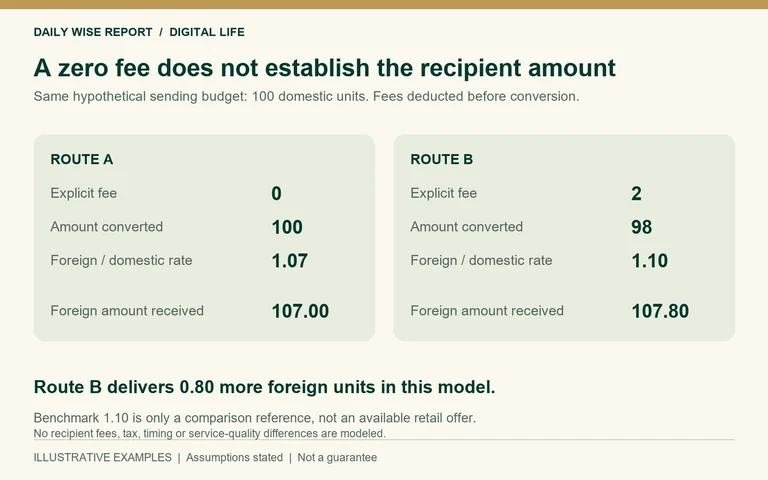
A Zero Transfer Fee Can Still Leave an Exchange-Rate Cost
A transaction’s explicit fee and its conversion rate both affect the amount received. The final comparison needs the same sending budget and charging assumptions.
Read full article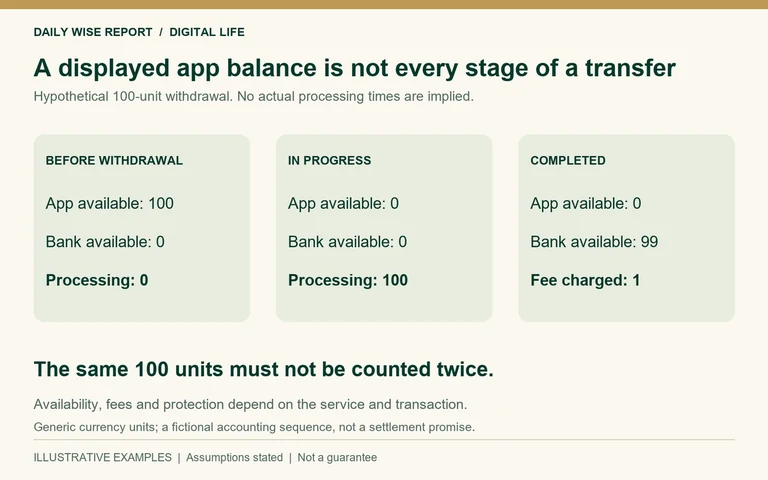 Analysis
A Payment App Balance Is Not Always Money Available in a Bank Account
An app balance, a withdrawal in progress and a bank’s available funds can represent different stages. A fast screen update does not establish the whole transfer process.
Read full article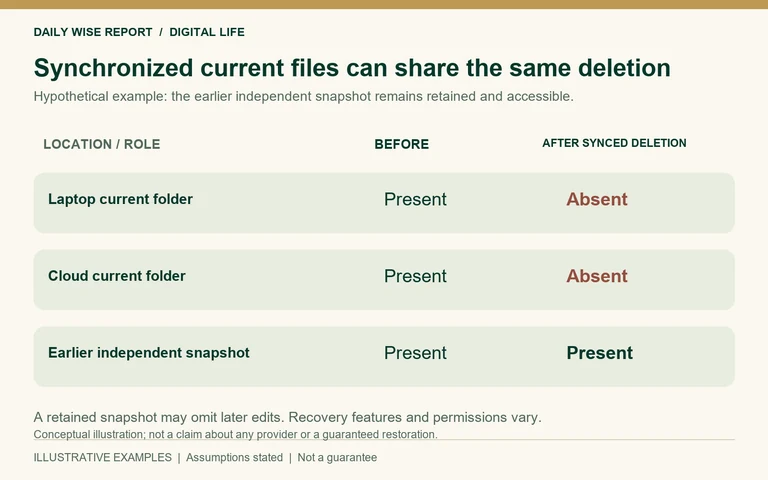 Analysis
Cloud Sync and Backup Can Protect Against Different Kinds of File Loss
Keeping current files consistent across devices is different from preserving an earlier recoverable state. More synchronized locations do not automatically mean independent recovery copies.
Read full article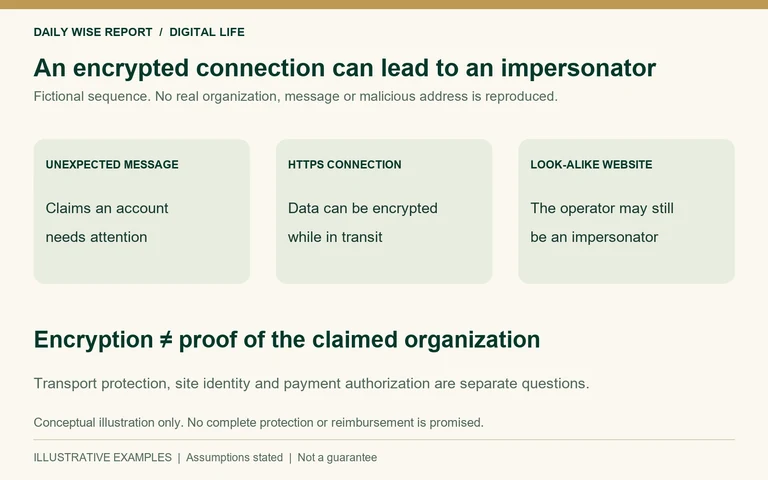 Analysis
HTTPS Can Protect a Connection Without Proving a Website Is Genuine
Encryption describes the route to a website. It does not establish that the website belongs to the organization a message claims to represent.
Read full article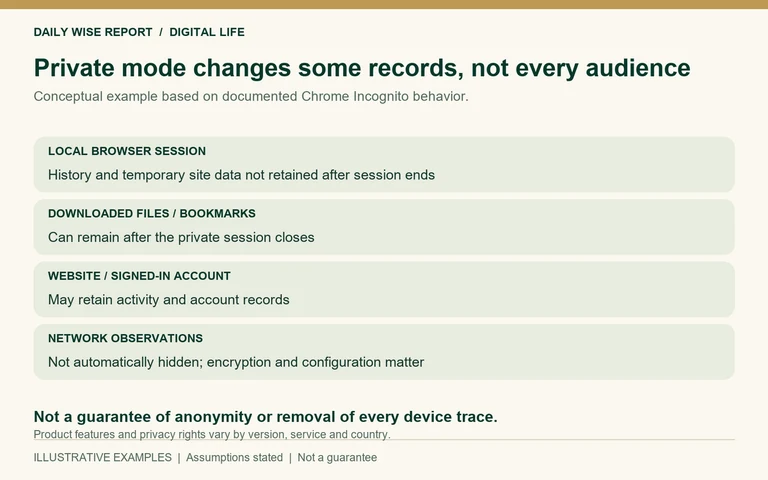 Analysis
Private Browsing Changes Local History, Not Every Privacy Boundary
A private window can limit what the browser retains on a device. Websites, signed-in accounts and network observations remain separate parts of the privacy picture.
Read full articleConvenience, data, and financial risk.
Explore digital payments, impersonation, privacy, and platform charges through clear explanations and practical scenarios.
Digital Payments
The difference between a fast interface and settled funds.
Explore concept ↓02Phishing & Impersonation
How a false identity becomes a financial risk.
Explore concept ↓03Data & Online Privacy
What digital activity can reveal.
Explore concept ↓04Platform Fees & Conversion
Where the cost of a digital service appears.
Explore concept ↓Digital Payments
Payment apps connect a user interface to underlying accounts and payment networks. Some services hold a balance; others move money directly between linked accounts. The same screen can conceal different settlement processes.
How it works
A transfer may appear in an app before funds are available elsewhere. Timing, holds, withdrawal methods, and account checks affect when money can actually be used.
Negative effects & limitations
Mistaken or scam-induced payments can be difficult to recover. Service outages and account restrictions can interrupt access. Refund rights and protection of stored balances depend on the transaction, provider, and jurisdiction.
Phishing & Impersonation
Phishing messages imitate trusted organizations or individuals to obtain credentials, personal information, or payments. The mechanism depends on deception rather than a legitimate relationship with the sender.
How it works
A hypothetical message claims that an account will be suspended and links to a look-alike login page. Entered details may be captured by the impersonator. A familiar logo or urgent wording does not establish authenticity.
Negative effects & limitations
Consequences can include account takeover, unauthorized transactions, and identity misuse. Tactics evolve, and a polished message may still be fraudulent. Warning signs are indicators, not a complete test of authenticity.
Data & Online Privacy
Websites and apps may use cookies, pixels, and other technologies to collect information about visits and activity. Some collection supports essential functions or analytics; other collection supports advertising or profiling.
How it works
First-party collection occurs through the service being used. Third-party technologies can connect activity across services, depending on the technology, permissions, and device or browser settings.
Negative effects & limitations
Profiling can expose interests or enable unwanted targeting. Data sharing and breaches can create additional risks. Not all tracking has the same purpose, and privacy rights or consent requirements vary internationally.
Platform Fees & Conversion
A platform can charge for a transfer, a withdrawal, faster availability, or currency conversion. An advertised zero transfer fee does not necessarily mean the whole transaction has no cost.
How it works
In a hypothetical transaction, 100 currency units incur a 2% transfer fee and a separate 1-unit withdrawal charge. If both are deducted from that amount and no conversion occurs, 97 remains. Actual charging methods differ.
Negative effects & limitations
Small repeated fees can accumulate. Exchange-rate markups and withdrawal costs may reduce the amount ultimately usable. Speed claims depend on the route and receiving institution; fee schedules and protections are not uniform.
Sources & scope
FTC resources describe common digital-service and fraud mechanisms. The CFPB reference addresses US remittance marketing. These sources do not establish identical consumer rights, reimbursement rules, or privacy obligations in every country.
The fee example and phishing scenario are hypothetical, not descriptions of a specific provider or incident. Provider terms, technical processes, and local laws vary. Reviewed October 15, 2026.
This page explains mechanisms and consequences; it does not recommend payment providers or promise protection against fraud.
Explain the system
Distinguish the interface from the underlying service.
Examine the consequences
Include financial loss, privacy exposure, and access limitations.
State the boundaries
Identify regional differences and uncertainty.