HTTPS Can Protect a Connection Without Proving a Website Is Genuine
Encryption describes the route to a website. It does not establish that the website belongs to the organization a message claims to represent.
An impersonator can operate a website over an encrypted connection. A familiar-looking page may therefore receive information securely while sending it to someone the visitor never intended to trust.
Encryption has a specific boundary
The US Federal Trade Commission’s public-Wi-Fi explanation notes that a scam website can receive information through an encrypted connection. HTTPS protects the connection to a domain; it is not a general endorsement of that domain’s business or of claims made in a message.
The sequence below is fictional; it contains no real organization, message or malicious address.
| Question | What HTTPS alone establishes |
|---|---|
| Is the connection encrypted? | Transport encryption, subject to normal browser validation |
| Does the site belong to the claimed organization? | Not established by HTTPS alone |
| Is the request legitimate? | Not established by HTTPS alone |
| Is a proposed payment authorized by the user? | Not established by HTTPS alone |
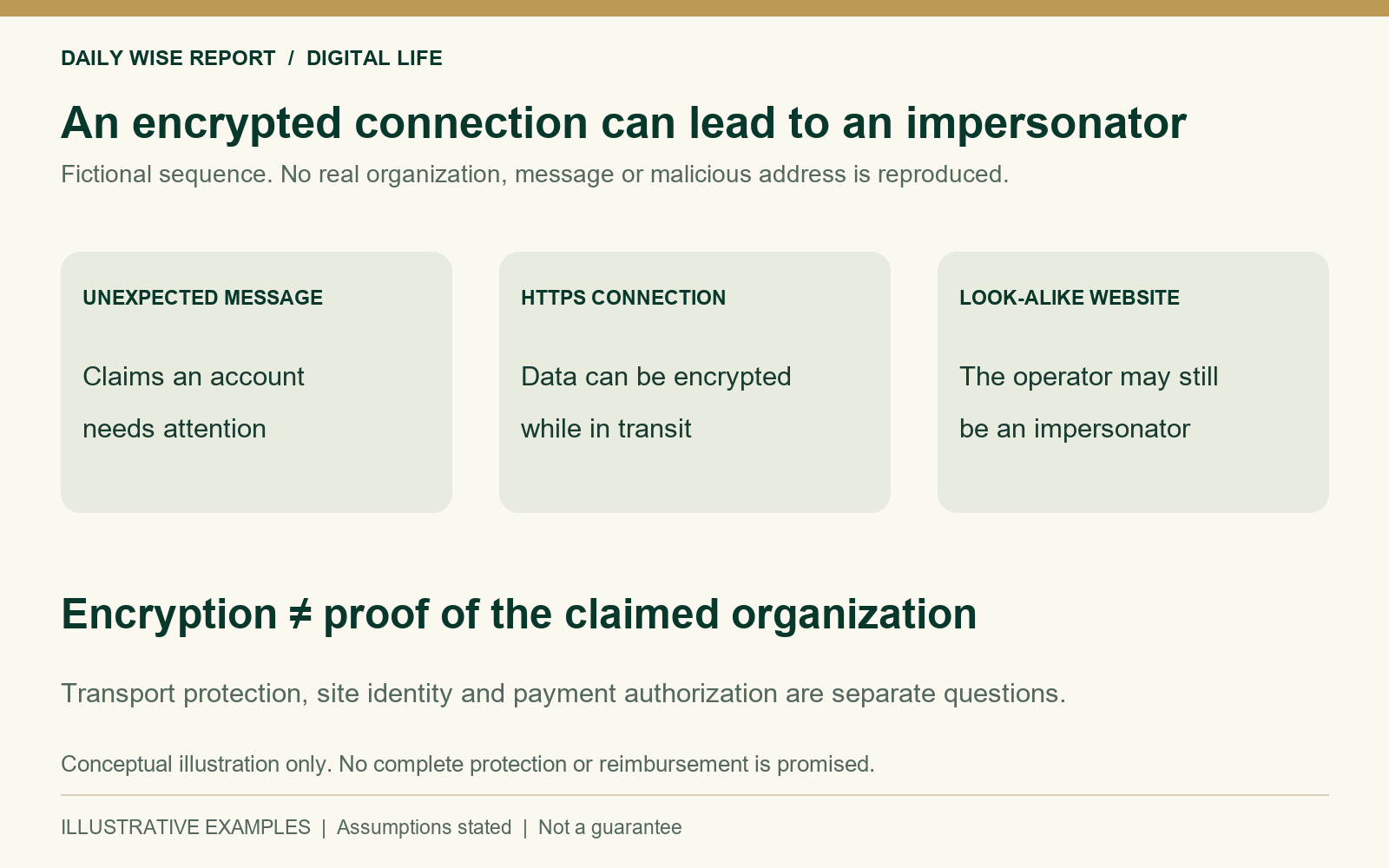
A plausible message can lead to the wrong recipient
Imagine an unexpected notification claiming that an online account needs attention. It points to a page with a familiar-looking design. The page uses HTTPS, but in this scenario its operator is an impersonator. Information submitted there reaches that operator through an encrypted channel.
In this example, encryption delivers the information to the impersonator’s site as intended. The logo and polished design give the visitor a false impression of who operates that site; urgency in the message supplies no proof either.
The risk can move from information to account access
The FTC’s phishing explanation describes impersonation through messages intended to obtain personal or financial information. Consequences can include account misuse and identity-related harm. Not every suspicious-looking message is fraudulent, and a well-written one is not necessarily legitimate.
Receiving the message and submitting credentials expose the recipient to different risks. Any later request for a verification code or payment raises a further authorization question, even if an earlier part of the exchange was authentic.
Login security and payment authorization
Account authentication, transport encryption and transaction authorization are separate mechanisms. An additional login factor can make account access harder for an intruder, but it does not convert an impersonator’s request into an authorized one. Outcomes depend on the factor, session and transaction controls.
No fixed probability of loss can be inferred from the visual cues in this scenario. A complete assessment would require the actual destination, account context and service behavior.
Scope and limitations
This is an explanatory scenario, not an incident report or a claim of complete protection. Browser interfaces and attack methods evolve. No provider is endorsed and no reimbursement outcome is promised.
Leave a Reply