A Zero Transfer Fee Can Still Leave an Exchange-Rate Cost
A transaction’s explicit fee and its conversion rate both affect the amount received. The final comparison needs the same sending budget and charging assumptions.
A zero transfer fee can accompany an unfavorable conversion rate or deductions at the receiving end. The amount the recipient can spend depends on all of those charges, measured against the same total sending budget.
The exchange rate is part of the price
The World Bank’s remittance-pricing methodology distinguishes transaction fees from exchange-rate margins and notes that several service features affect cost comparisons. An exchange-rate cost can exist without appearing as a separate fee.
Our example fixes the sender’s total budget at 100 domestic units. Any explicit sending fee is deducted before conversion. A benchmark of 1.10 foreign units per domestic unit is used only for comparison; it is not assumed to be a retail rate available to the sender.
| Measure | Route A | Route B |
|---|---|---|
| Sending budget | 100 | 100 |
| Explicit fee deducted first | 0 | 2 |
| Domestic amount converted | 100 | 98 |
| Foreign units per domestic unit | 1.07 | 1.10 |
| Foreign amount received | 107.00 | 107.80 |
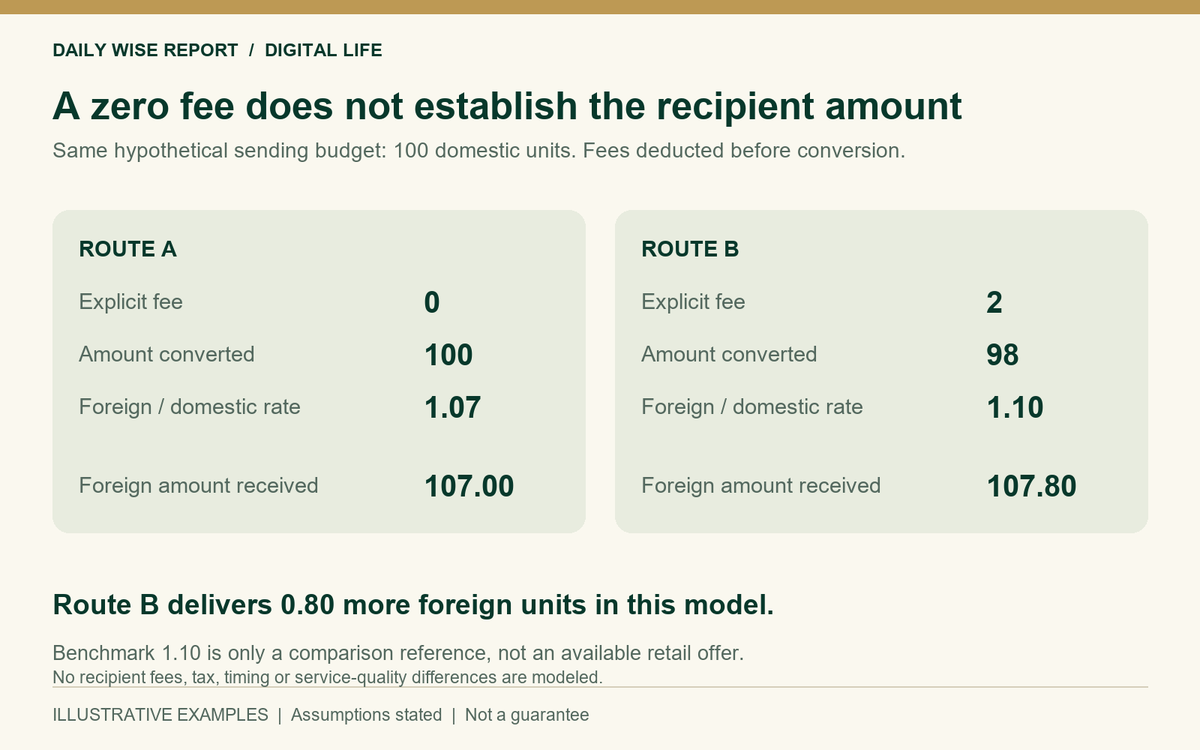
The zero-fee route does not produce the larger amount here
Route A delivers 100 × 1.07, or 107 foreign units. Route B delivers (100 − 2) × 1.10, or 107.80. The result differs by 0.80 foreign units, even though Route B has an explicit fee.
Relative to the invented no-cost benchmark of 110, Route A’s shortfall is three foreign units, about 2.73%. Route B’s is 2.20, or 2%. These are modeled comparison gaps, not a calculation of either provider’s profit or a claim that a real sender could transact at the benchmark.
A fee paid on top changes the comparison
If the sender converts 100 and pays a two-unit fee on top, total spending is 102. Comparing the resulting receipt with a route that costs 100 in total would compare unequal budgets.
A receiving-bank charge would further reduce the usable proceeds. A quotation that ends at transfer arrival may leave out a cost incurred before the recipient can spend the money.
When quotations expire
The model fixes both rates at the same moment and assumes no later deductions. Real quotations can expire, and different payment methods or arrival speeds can have different terms. A larger modeled recipient amount does not establish that a route is available, reliable or suitable.
Scope and limitations
All rates and routes are fictional. No current currency quotation, provider ranking or transfer recommendation is presented. Local disclosure rules and transaction protections are not assumed to be identical worldwide.
Leave a Reply