A Payment App Balance Is Not Always Money Available in a Bank Account
An app balance, a withdrawal in progress and a bank’s available funds can represent different stages. A fast screen update does not establish the whole transfer process.
A payment notification can arrive while the money is still unavailable in the recipient’s bank account. The app may show its own balance first, with a separate withdrawal needed before the recipient can spend the funds through the bank.
The interface is only one layer
The US Federal Trade Commission’s payment-app explanation describes a model in which incoming funds appear in an app balance and can later be transferred to a bank. Not every service operates that way: some initiate movement between linked accounts without the same stored-balance arrangement.
The following imaginary service holds a balance and charges one unit for the modeled withdrawal. The stages are an accounting illustration, not a real provider’s transfer schedule.
| Stage | Available in app | Processing | Available in bank | Fee charged so far |
|---|---|---|---|---|
| Before withdrawal | 100 | 0 | 0 | 0 |
| Withdrawal in progress | 0 | 100 | 0 | 0 |
| Completed | 0 | 0 | 99 | 1 |
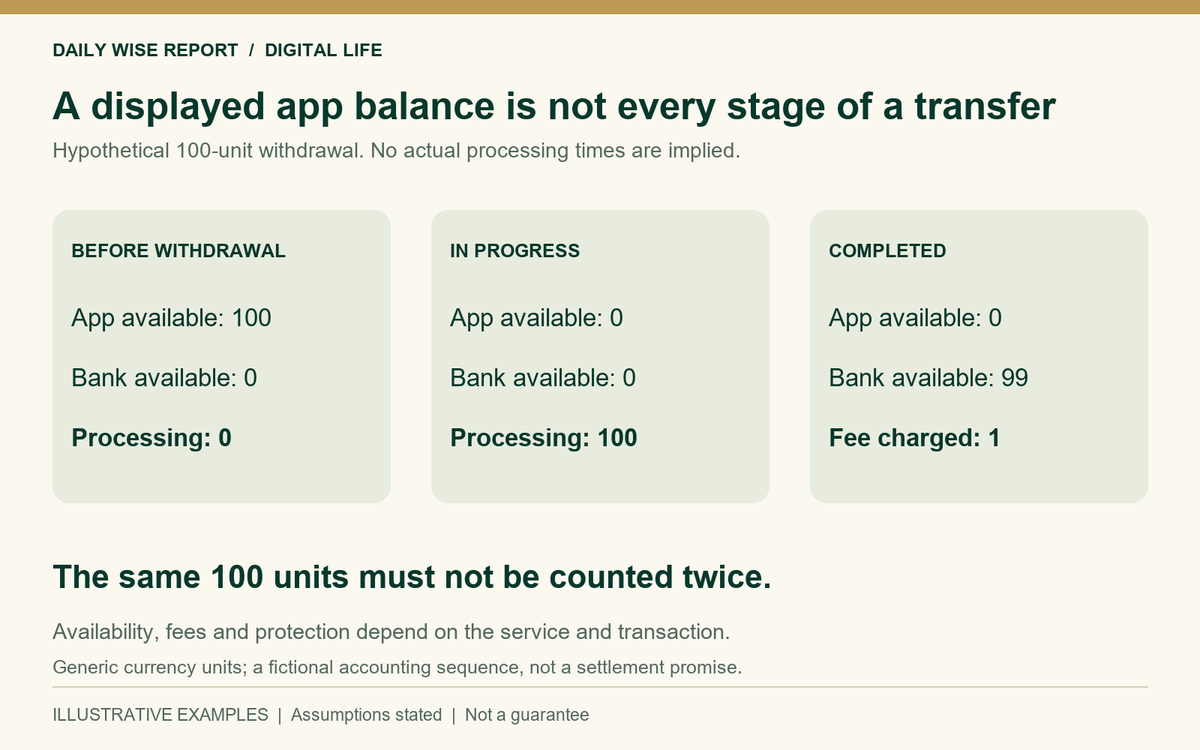
Where the 100 units go during withdrawal
During withdrawal, the 100 units sit in the processing column, with nothing immediately spendable in either account. Adding the old app balance to a pending bank credit would count that same 100 twice.
Once the withdrawal finishes, the bank has 99 available and the service has charged one unit. This assumes the fee is deducted at completion. Actual apps may charge separately or display pending funds differently.
Access and protection answer different questions
The Consumer Financial Protection Bureau explains that US deposit-insurance treatment differs across payment apps. A displayed balance alone does not identify the legal holder, an underlying bank or whether the necessary coverage conditions are met.
Deposit insurance concerns eligible losses from a bank failure. Access during an outage, a disputed payment or a processing delay depends on other conditions. Whether a particular account qualifies for insurance requires its own assessment.
Speed labels need a defined endpoint
A claim of instant service might refer to the notification or the app balance, while withdrawal to a bank takes longer. No elapsed time is assumed here: the route, receiving institution and transaction conditions determine the actual delay.
Scope and limitations
The service and amounts are fictional. Fees, holds, reversal rules and consumer rights differ across providers and countries. This article explains transaction states without recommending a payment app or promising availability or reimbursement.
Leave a Reply