Mean and median income: what each number shows
A five-household example shows why an average can sit well above the middle value.
By Oliver Grant · · Daily Wise Report
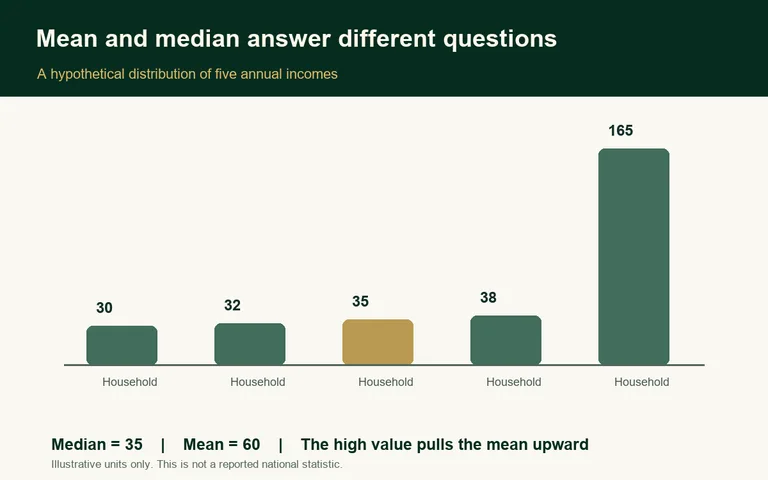
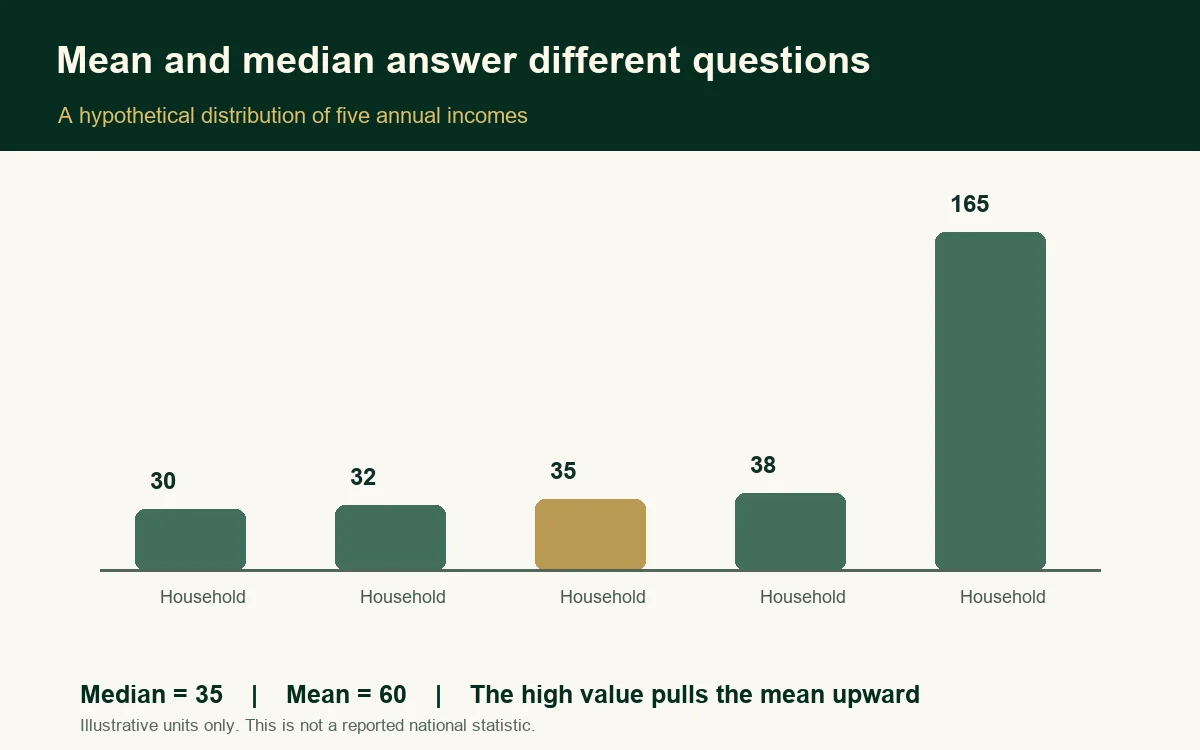
Suppose five households have annual incomes of 30, 32, 35, 38, and 165 units. The median is 35, the middle value after sorting. The mean is 60, found by adding the values and dividing by five. One high observation pulls the mean well above what four of the five households receive.
Both figures describe the same small distribution, but answer different questions. The mean measures the total divided across all observations. The median identifies the midpoint. One figure alone can hide how uneven the values are.
How the calculation works
Add the observations and divide by their count to calculate a mean. Here the total is 300 units, and 300 divided by five is 60. Each household contributes equally to the arithmetic sum, so a very high or low value can move the result.
To find the median, put observations in order and locate the central one. With five households, that is the third value, 35. With an even number, the median is commonly calculated from the two middle values. Statistical releases should explain their method.
These invented values explain the arithmetic. They are not a national income estimate and do not represent a particular currency.
What the gap can tell you
When a distribution has a long upper tail, high values can lift the mean above the median. That gap is consistent with many observations falling below the mean. It does not reveal exactly how many people face hardship or why the distribution took that shape. Other measures are needed to describe the full range.
The U.S. Census Bureau defines median income as the point dividing a distribution into two equal groups. It calculates mean household income by dividing total household income by the number of households. Comparisons still depend on which households and income definition the statistic includes.
| Measure | Calculation | Result | Summary |
|---|---|---|---|
| Mean | (30 + 32 + 35 + 38 + 165) ÷ 5 | 60 | Total divided by count |
| Median | Middle value in sorted list | 35 | Distribution midpoint |
Check what is being compared
A published median may refer to households, people, workers, or another group. Household size changes how far an income stretches. Some measures report income before tax; others account for taxes, transfers, or household composition. A comparison can shift when a definition changes.
Time comparisons also need consistent price adjustments. Nominal income is stated in the money of the period measured. Real income adjusts for price changes using a chosen index. A nominal rise alone does not establish that purchasing power improved. The result depends on the inflation measure, reference period, and population.
The median is less sensitive to an extreme value than the mean, but it hides differences on either side of the midpoint. Two places can share a median while having different lower incomes, upper incomes, or household composition. A mean helps describe totals and averages. Neither measure alone describes distribution or living costs.
Scope and limits
This arithmetic example is hypothetical. Official statistics use definitions, survey methods, weighting, and uncertainty ranges that vary by country and release. Compare the documentation alongside a headline figure, particularly when using it to describe living standards.
Sources: U.S. Census Bureau: income FAQs; OECD: indicators for household distributions.
Oliver Grant Editorial Policy · Corrections
Leave a Reply