How Compound Interest Works—and What the Headline Rate Leaves Out
A growing balance is only part of the story. Timing, fees, and changing prices shape what that growth means.
Compound interest is calculated on a balance that includes earlier interest. With fixed inputs, the arithmetic is predictable; actual results also depend on whether those inputs hold. The CFPB explains how this differs from earning interest on principal alone. [1]
A three-year example
Assume an opening balance of 2,000 currency units, a fixed annual rate of 4%, and interest credited once at each year-end. There are no contributions, withdrawals, fees, or taxes. This is a hypothetical calculation, not a deposit offer or investment forecast.
| Year | Opening balance | Interest | Closing balance |
|---|---|---|---|
| 1 | 2,000.00 | 80.00 | 2,080.00 |
| 2 | 2,080.00 | 83.20 | 2,163.20 |
| 3 | 2,163.20 | 86.53 | 2,249.73 |
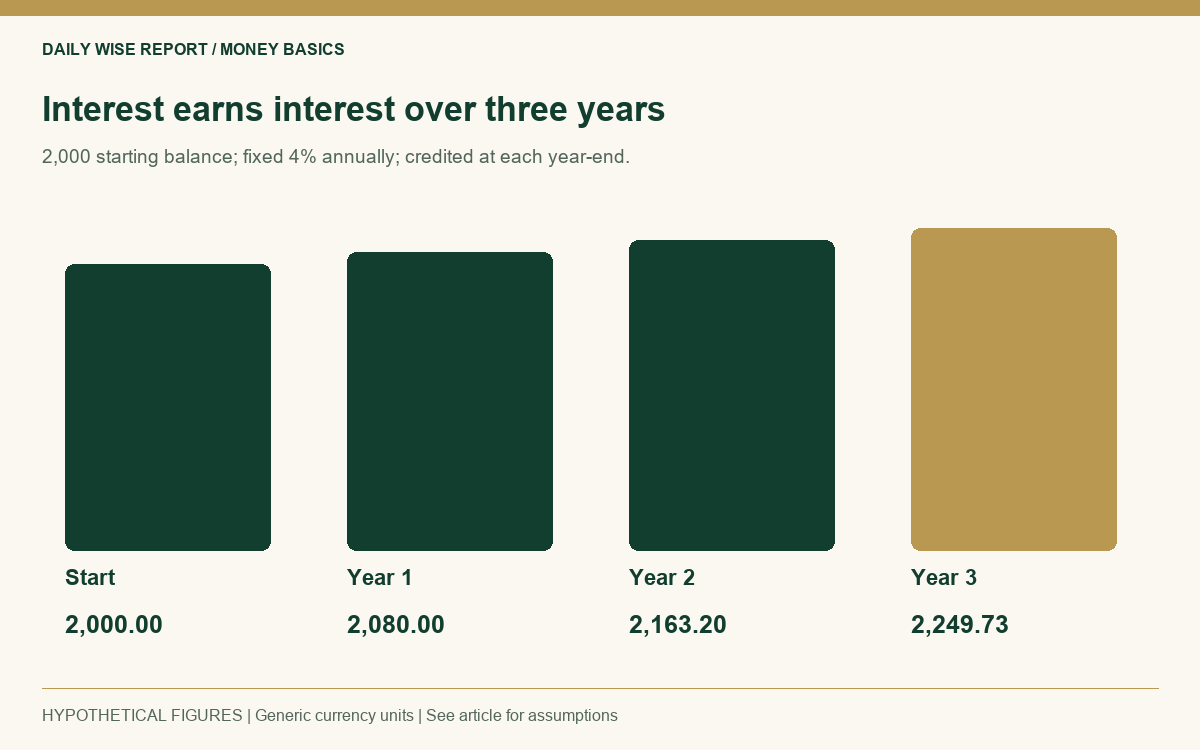
At 4% simple interest, the original 2,000 earns 80 each year and reaches 2,240 after three years. Compounding adds 9.73 more through interest on earlier interest, with the stated rate unchanged.
Why frequency changes the calculation
For a fixed nominal annual rate, dividing the year into more compounding periods changes the outcome if the rate per period is adjusted accordingly. With principal P, nominal annual rate r, n compounding periods per year, and t years, the simplified formula is P × (1 + r/n)^(nt).
Rates described as effective annual yields may already incorporate compounding. Treating an effective annual rate as a nominal rate and compounding it again would overstate the result. Investor.gov’s calculator separates the initial balance, contributions, estimated rate, time, and compounding frequency. The headline percentage alone leaves those other inputs unspecified. [2]
Contributions are not interest
A balance may grow because someone adds money, because interest is credited, or both. If the owner adds 500 units near the end of the example’s first year, the closing balance changes substantially even if almost no interest is earned on that late contribution. Comparing the new balance with the original deposit without separating contributions would misdescribe performance.
Negative effects and omitted costs
A fee reduces the amount left to compound. Taxes can reduce credited interest, while inflation changes what the final balance buys. For illustration, a one-year nominal gain of 4% alongside a 5% rise in the price of the same basket changes purchasing power by 1.04 ÷ 1.05 − 1, approximately −0.95%. The balance rises while its purchasing power falls.
Compounding can also increase a debt balance when contractual rules add unpaid interest to principal. Not every loan uses the same method: repayment timing, interest capitalization, fees, and local rules matter. A savings formula is not automatically a model of a credit-card or loan agreement.
When the constant-rate calculation changes
Retaining interest allows the balance to earn further interest. The constant-rate result depends on the rate, payment dates and included costs, and supplies no guarantee of a return, product safety or suitability.
Sources and scope
[1] CFPB: How compound interest works. [2] Investor.gov: Compound interest calculator. For nominal and real rates, see Bank of England: Monetary policy transmission, Box A. These primary sources support general concepts; national product disclosures and tax rules differ. Calculations above are independently constructed illustrations, rounded to two decimal places.
Leave a Reply