Cash Flow Is Not Net Worth: Why Timing Can Create a Shortfall
A household can own valuable assets and still lack cash when a bill is due. The distinction is about time as well as totals.
Cash flow follows the money entering and leaving during a period. Net worth subtracts liabilities from assets at a particular date. A household can have positive net worth and still be short of cash before a bill is due.
The CFPB’s personal balance-sheet material defines net worth as assets less liabilities. A positive figure does not by itself show whether those assets can fund an immediate payment. [1]
A positive month with an early gap
Consider a hypothetical household with an opening cash balance of 200 currency units. Income of 1,000 arrives in each of weeks two and four. Payments are 500, 400, 500, and 400 across the four weeks. There are no other cash movements.
| Week | Opening | Income | Payments due | Projected closing |
|---|---|---|---|---|
| 1 | 200 | 0 | 500 | −300 |
| 2 | −300 | 1,000 | 400 | 300 |
| 3 | 300 | 0 | 500 | −200 |
| 4 | −200 | 1,000 | 400 | 400 |
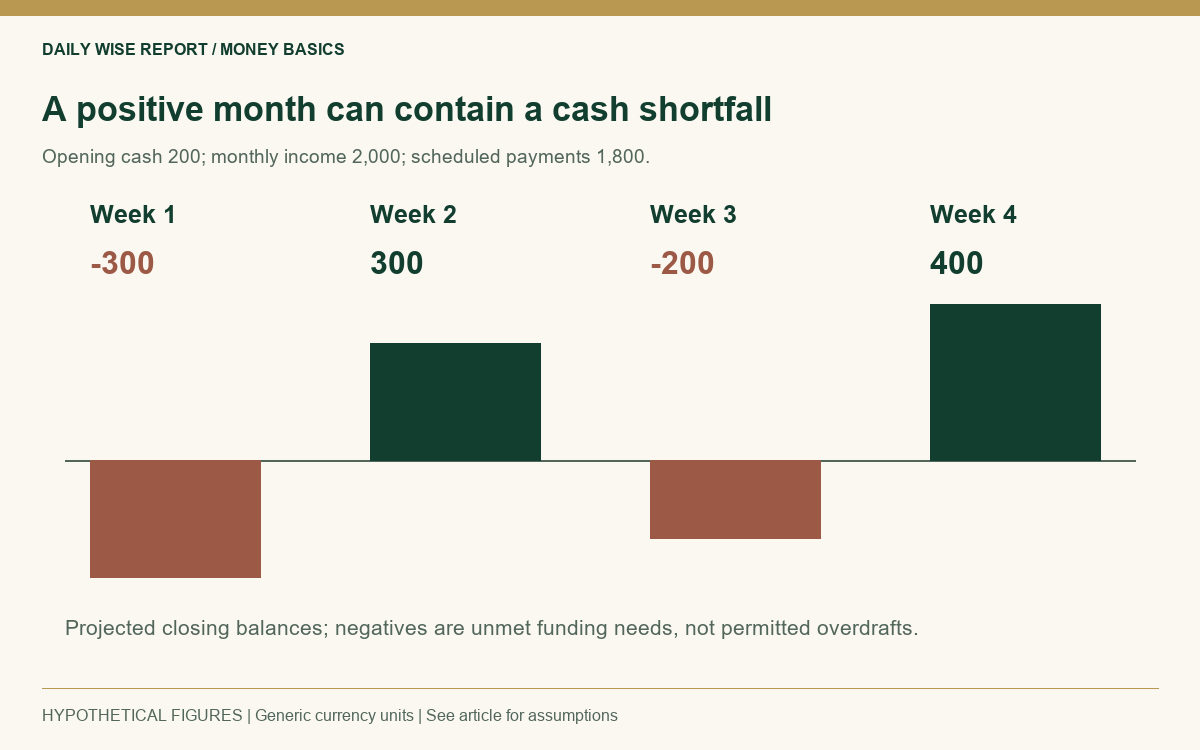
Income totals 2,000 and scheduled payments total 1,800. The monthly net inflow is positive by 200, but the timing produces projected gaps in weeks one and three. The negative rows represent unmet funding needs, not an assumption that a bank will permit an overdraft. Actual payment outcomes depend on available funds and account terms.
The CFPB’s cash-flow worksheet similarly follows beginning balances, incoming resources, outgoing amounts, and ending balances across weeks. Its purpose is to expose timing that a monthly total can conceal. [2]
Why an asset does not automatically solve the gap
In a simplified balance sheet, an asset estimated at 20,000 less debt of 8,000 gives net worth of 12,000. Funding the first bill still requires 300 in accessible cash before its deadline.
Selling the asset may take time and incur costs, and the eventual price may be below its valuation. Those uncertainties separate its balance-sheet value from the cash available for an immediate payment; no particular asset or market is assumed here.
Borrowing changes both statements
If the household borrows 300, cash increases by 300 and liabilities also increase by 300. Ignoring fees and interest, that transaction alone does not increase net worth. Repaying principal later reduces both cash and the liability. Interest or a fee creates an additional cost.
Likewise, a transfer from one household-owned account to another changes where money sits but is not new household income. Counting both the original income and the internal transfer as earnings would overstate cash generation.
Negative effects of a timing mismatch
A projected shortfall can become a declined payment, a delayed obligation, or a need for financing. Any resulting charge makes a later period harder to fund. The hypothetical table excludes those knock-on costs, so it cannot establish the final outcome once a gap occurs.
Irregular earnings and infrequent expenses also limit the meaning of a single positive month. A repair paid once a year can be absent from the observed period without disappearing from the household’s obligations. CFPB budgeting guidance identifies bill and income timing as one reason a household can run short despite its overall budget. [3]
Reading the weekly gap alongside the balance sheet
The weekly sequence shows when funds are needed, while the monthly total measures net cash movement. The balance sheet adds what is owned and owed. These measurements help explain the timing gap without prescribing borrowing, asset sales or changes to payment arrangements.
Sources and scope
[1] CFPB: Personal balance sheets, Module 1 (PDF). [2] CFPB: Creating a cash-flow budget (PDF). [3] CFPB: Budgeting and timing. References are US educational resources; the examples use generic currency units and do not assert local credit, payment, or legal rules.
Leave a Reply