Why a Central Bank Rate Change Reaches People at Different Times
Policy rates, market rates and the rates on existing contracts do not move together automatically. Repricing dates and contract design shape the transmission.
After a central bank changes its rate, a household on a fixed contract may keep the same payment while another borrower’s cost changes soon afterward. The announcement reaches them through contracts with different repricing dates.
From market rates to existing contracts
The Bank of England’s explanation of monetary transmission distinguishes fast financial-market responses from slower effects on activity and prices. Existing contracts, refinancing and spending decisions can delay the second stage. This account of UK mechanisms does not assign a universal timetable to every economy.
The following examples assume particular contract rates. They are not current offers and do not assume that a policy-rate movement passes through one for one.
| Contract | Assumed earlier rate | Assumed later rate | Annual interest comparison |
|---|---|---|---|
| 10,000 fixed-rate debt before renewal | 3% | 3% | 300 to 300 |
| 10,000 debt that reprices | 4% | 6% | 400 to 600 |
| 5,000 deposit that reprices | 2% | 3% | 100 to 150 |
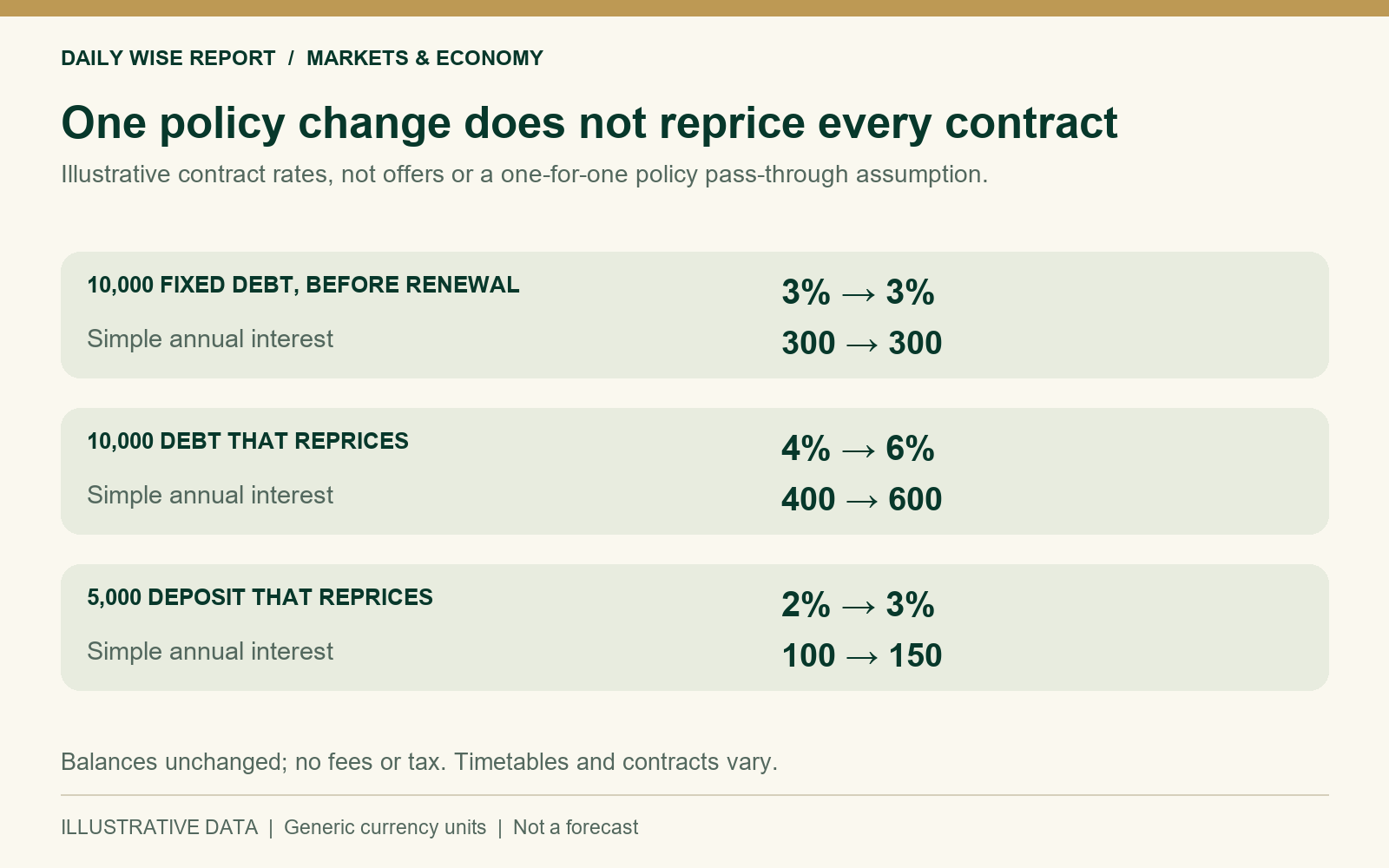
Interest on the first contract stays at 300 during the assumed fixed period, with renewal terms left open. The second contract adds 200 in annual interest, and the deposit adds 50 in gross interest income. These changes use the invented contract rates, without forecasting what lenders will offer.
Payments are not identical to interest
The debt figures isolate interest on an unchanged balance. An amortizing repayment also reduces principal, so its monthly payment cannot be calculated by dividing only these interest amounts by twelve. Outstanding balances and remaining terms matter.
A deposit’s higher quoted rate may apply only to a portion of the balance or under particular conditions. Such features are excluded from the model. A higher gross interest amount also does not establish a gain after tax or inflation.
Spending effects can pull in different directions
In our illustration, a borrower facing the additional 200-unit charge has less cash for other uses if income and all other costs remain unchanged. The depositor receives an extra 50. Their responses need not offset each other, since the balances, needs and willingness to spend may differ.
The IMF’s monetary-policy explainer discusses additional channels involving credit, exchange rates and expectations. These interactions mean that an isolated rate announcement is not enough to determine the outcome for employment, consumer prices or a currency.
Scope and limitations
Repricing speeds, policy frameworks and banking systems vary across countries. All contract figures here are invented. No fixed delay, exchange-rate response, economic growth outcome or market direction is predicted.
Related reading
Why Fixed-Rate Bond Prices Can Fall When Market Yields Rise
A Weaker Currency Creates Different Costs for Importers and Exporters
Leave a Reply