Why a Bank Account Fee Waiver Can Disappear from One Month to the Next
A minimum-balance rule can depend on the lowest day, the monthly average or qualifying deposits. Those measures can produce different results.
An account can qualify for a fee waiver one month and fail the next despite similar opening and closing balances. A bank may test the lowest daily balance, the average over the month or qualifying deposits, each of which can produce a different result.
Different tests can produce different results
The US Consumer Financial Protection Bureau explains that some institutions waive maintenance charges when a specified balance or direct-deposit condition is met. That describes US practices, not a universal entitlement. The agreement determines the applicable test.
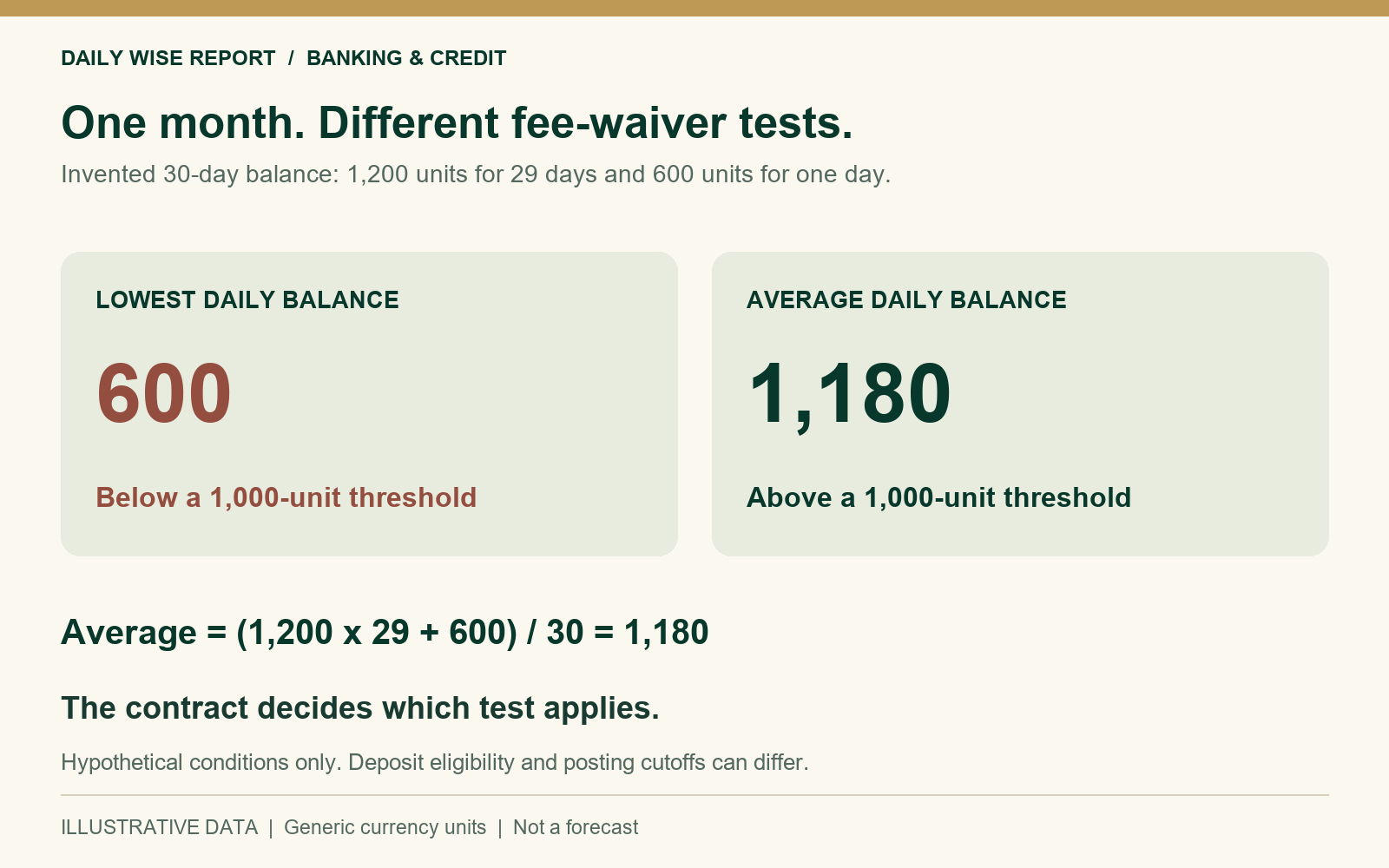
Consider a hypothetical 30-day period. The account holds 1,200 units for 29 days and 600 for one day. Its average daily balance is (1,200 × 29 + 600) ÷ 30, or 1,180 units. Its lowest daily balance is 600. Both observations are correct.
| Waiver condition | Observed result | Met? |
|---|---|---|
| At least 1,000 every day | Lowest day: 600 | No |
| Average daily balance at least 1,000 | Average: 1,180 | Yes |
| Qualifying deposits of at least 1,500 | Qualifying deposits: 1,400 | No |
A transfer may increase the balance without meeting the contract’s definition of a qualifying salary or benefit deposit. The example assumes the qualifying amount has already been identified. It does not establish which real-world transfers qualify.
Annual cost depends on failed periods
At eight units per failed month, the charge is eight for one month, 48 for six months and 96 for twelve. The annual cost therefore depends on how often the account misses the waiver conditions.
Other charges can have separate triggers. Maintenance could be waived while an applicable transfer, currency-conversion or out-of-network withdrawal charge remains. A waiver headline does not establish whether those charges exist.
A balance condition can create pressure elsewhere
If 1,000 units must remain to meet a waiver condition and total accessible cash is 1,100, only 100 lies above that threshold. This is an accounting constraint in the example, not a restriction on the legal right to withdraw.
Withdrawing the money may still be allowed, but it could trigger a fee. Leaving it in the account to meet the condition also leaves less cash for other bills. Any possible income from another use would need a separate assessment of costs and uncertainty.
Scope and limitations
All balances, thresholds and fees are hypothetical. Daily cutoffs, posting dates and eligible deposits differ by institution and country. This article explains account conditions; it does not rank products or recommend a balance.
Leave a Reply