Lower Rent Does Not Always Mean Lower Monthly Living Costs
Utilities, commuting and the timing of deposits can alter the comparison between two rental homes. The rent headline is only one line of the calculation.
An apartment’s lower rent can be offset by higher utility bills or commuting costs. A deposit creates a further cash requirement at the start, though a refundable amount is accounted for differently from a recurring expense.
Rent, utilities and commuting
The US Consumer Financial Protection Bureau’s housing comparison tool notes that rental agreements differ in which utilities are included. This supports separating the advertised payment from other costs; it does not establish the contents of any reader’s lease.
The table assumes the same household and a one-month comparison. Every cost is invented. Utilities are charged separately in both homes, and commuting reflects only the modeled cash expense.
| Cost | Home A | Home B |
|---|---|---|
| Rent | 800 | 850 |
| Utilities | 150 | 70 |
| Commuting | 100 | 40 |
| Total modeled monthly expense | 1,050 | 960 |
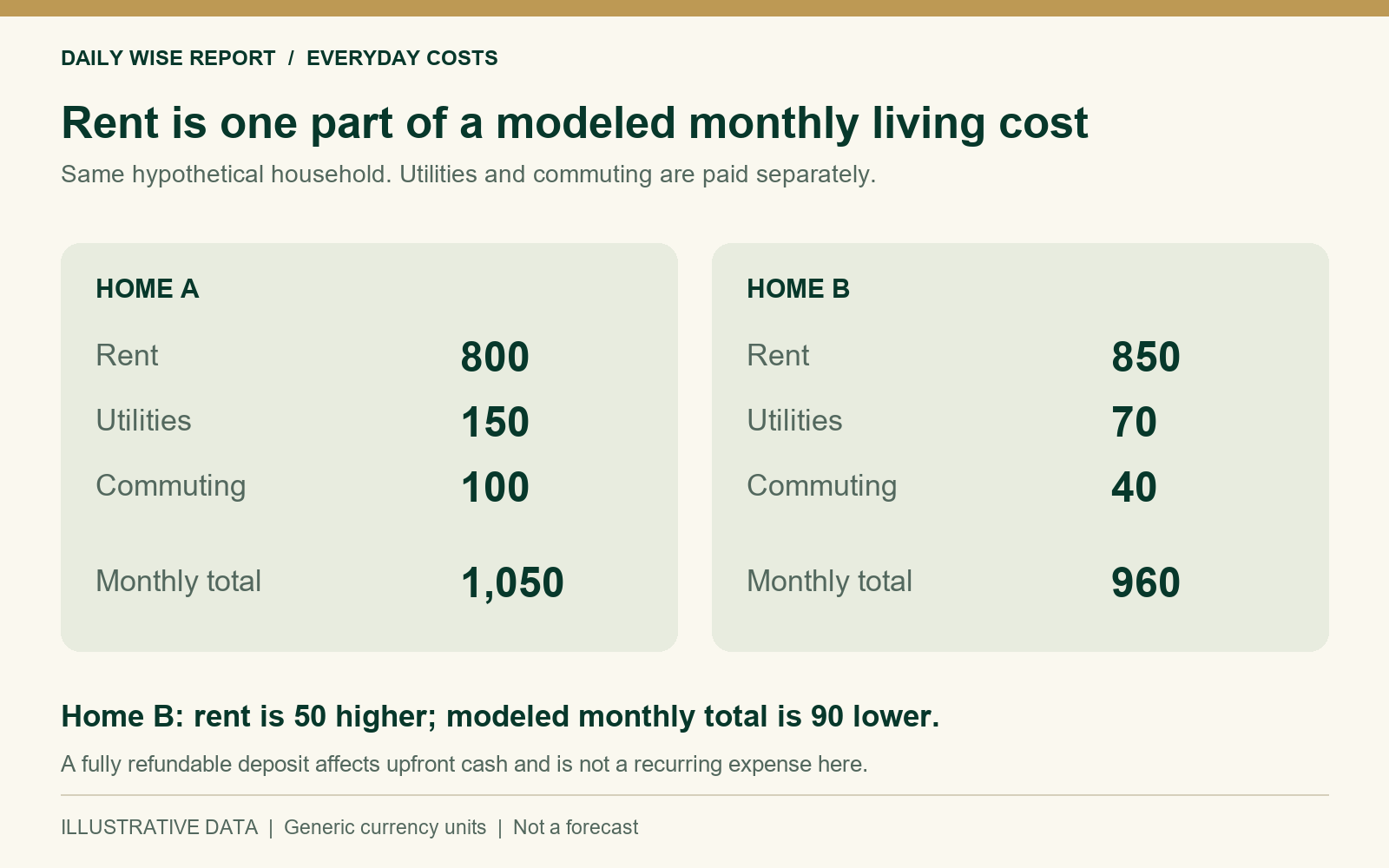
Home B charges 50 more in rent but 140 less for the assumed utilities and commute, leaving its monthly total 90 lower. Availability and suitability for an actual household remain outside this calculation.
An upfront deposit is a different measurement
Suppose the fictional homes also require deposits of 1,200 and 1,700 respectively. Assume these are fully refundable, carry no interest and are returned in full later. The initial cash required for one month’s modeled expenses plus the deposit becomes 2,250 for Home A and 2,660 for Home B.
Home B requires 410 more upfront despite its lower monthly expense. Under the full-refund assumption, the deposit temporarily ties up cash. It belongs in the initial cash requirement, while treating the entire deposit as monthly spending would overstate recurring expense.
Not every cost repeats at the same interval
Moving, furnishing or connecting services can add one-time outlays. Dividing those by an assumed number of months produces an allocation, not a prediction of how long someone will stay. A short tenancy spreads the same initial amount across fewer months.
Travel time, accessibility and maintenance responsibilities are excluded, as are service charges and insurance. Some involve further payments; others affect how usable the home is. The total covers only the cash expenses listed.
Scope and limitations
Deposit treatment, tax, utility arrangements and tenant protections vary by agreement and country. No local legal rule is assumed. This illustration analyzes cost categories and timing, without ranking properties or recommending a housing decision.
Related reading
Cost per Kilometre Can Fall While Monthly Driving Costs Rise
Why Using Less Electricity May Not Lower the Bill by the Same Percentage
Leave a Reply