A Cheaper Appliance Purchase Can Have a Higher Five-Year Energy Cost
Upfront price and annual operating expense can point in different directions. The result depends on usage, energy rates and how long the appliance remains in service.
An appliance with a lower purchase price can cost more over several years if its electricity costs are higher. How long it stays in use and the energy price determine whether that initial saving lasts.
An operating-cost estimate is conditional
The US Federal Trade Commission’s EnergyGuide explanation describes labels that present energy-use and estimated operating-cost information. Actual spending can differ with usage and local energy prices. US labeling conventions are not assumed to apply to every country.
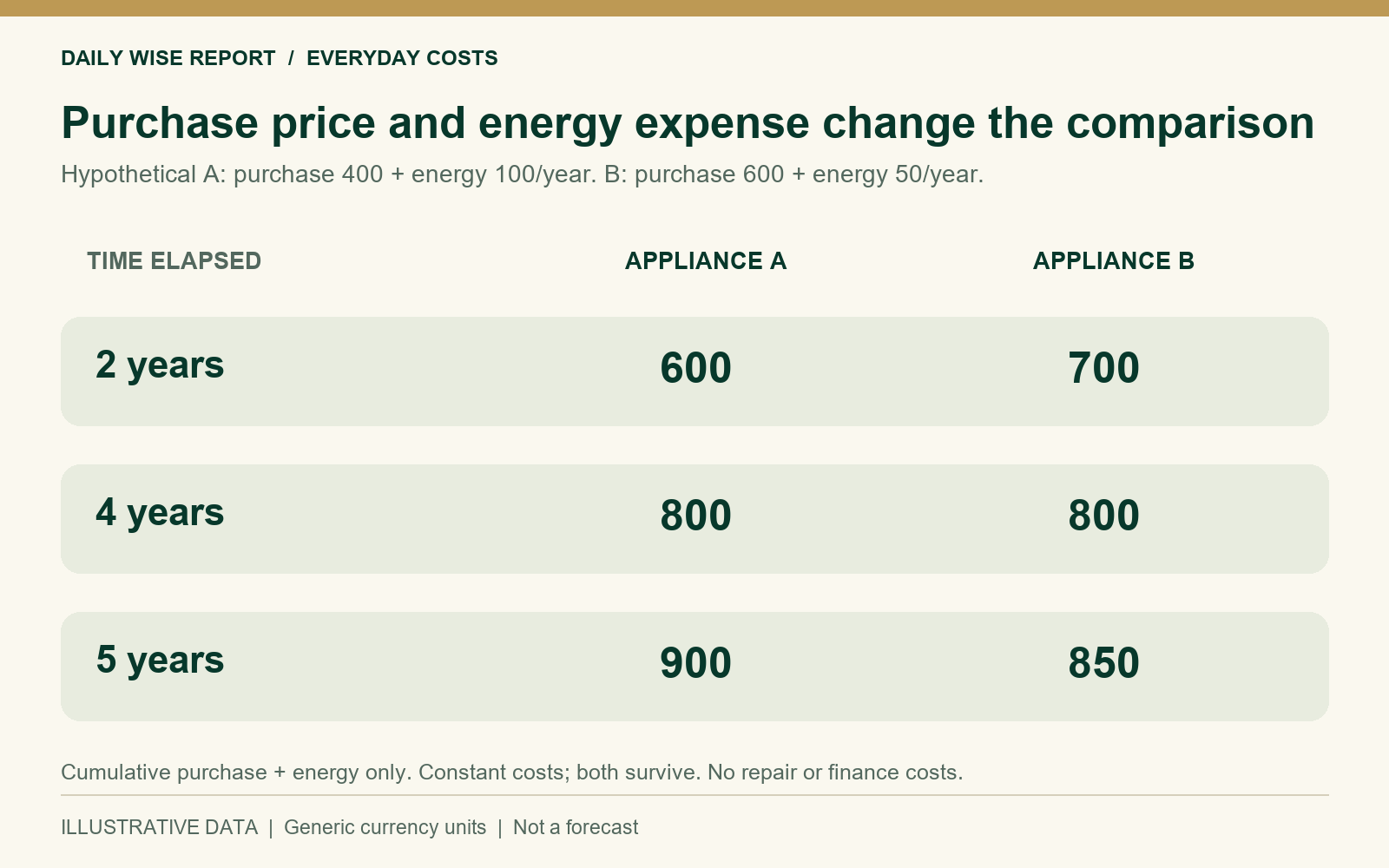
Our fictional appliances have the same useful capacity and function. Appliance A costs 400 and is assumed to use 100 units of energy spending annually. Appliance B costs 600 and is assumed to use 50 annually. These are invented monetary estimates, not measurements from product labels.
| Time elapsed | Appliance A | Appliance B |
|---|---|---|
| At purchase | 400 | 600 |
| After 2 years | 600 | 700 |
| After 4 years | 800 | 800 |
| After 5 years | 900 | 850 |
The comparison crosses at a particular time
Appliance B’s initial premium is 200. Under the unchanged annual assumptions, its energy expense is 50 lower each year. Dividing 200 by 50 gives four years, the point where the modeled cumulative totals match.
After two years, A costs 100 less in total; after five, B costs 50 less. Both results rely on the appliances lasting for those periods and the energy-cost assumptions holding.
Lower use can move the crossing point
In a separate scenario where annual energy costs are half as large for both appliances, they become 50 and 25. The annual difference shrinks to 25, so the same 200 premium takes eight years to offset in simple undiscounted arithmetic.
This change could represent different usage or rates within the model. It does not predict that a real appliance’s energy use changes proportionally under every operating condition.
Other ownership costs
Installation, repairs, water and disposal are excluded, along with resale value, financing and the value of paying at different times. Those costs could change the result, especially when repair costs or useful lifetimes differ.
Paying more initially may require cash that is unavailable for other obligations. Conversely, a lower purchase price leaves the user exposed to the assumed future operating expense. Neither observation by itself establishes which choice is appropriate.
Scope and limitations
The model assumes both appliances remain usable for every stated period and that prices stay constant. It is not a full life-cycle assessment or a forecast of savings. No model, brand or replacement decision is recommended.
Related reading
Why Using Less Electricity May Not Lower the Bill by the Same Percentage
Cost per Kilometre Can Fall While Monthly Driving Costs Rise
Leave a Reply