Why a Credit Card Payment Does Not Reduce Debt by the Same Amount
Part of a payment may cover interest or fees before the principal falls. New spending can offset the reduction altogether.
Interest or new spending can offset part of a credit card payment. Fees and credits also enter the calculation, so a payment of 100 may reduce the ending balance by less than 100.
Reconcile payments with the balance change
Imagine a 1,000-unit opening balance, a 2% periodic interest charge added before payment, and a 100-unit payment. With no fees or spending, interest is 20 and the ending balance is 920. Debt falls by 80 rather than 100.
| Period | Opening balance | Interest | Payment | Ending balance |
|---|---|---|---|---|
| 1 | 1,000.00 | 20.00 | 100.00 | 920.00 |
| 2 | 920.00 | 18.40 | 100.00 | 838.40 |
| 3 | 838.40 | 16.77 | 100.00 | 755.17 |
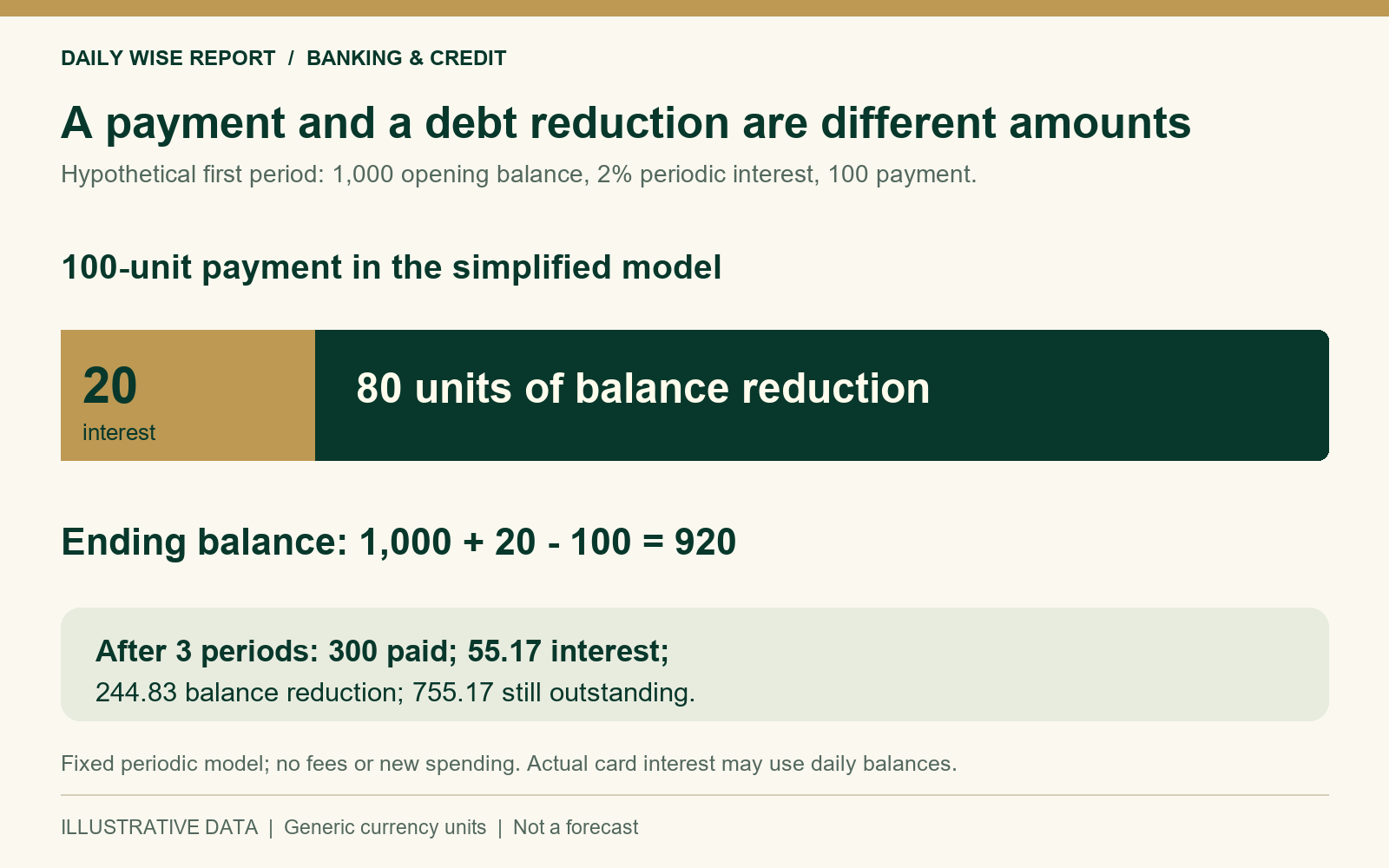
Across the three periods, payments total 300 and interest totals 55.17, rounded to 0.01 each period. Subtracting that interest leaves a balance reduction of 244.83, which accounts for the gap even when every payment is credited.
Real cards may use daily information
The US Consumer Financial Protection Bureau explains that many issuers calculate interest using daily balances. The table instead uses an opening balance for each period to make the mechanism visible. It cannot reproduce a statement with purchases and payments on different days.
A 2% periodic rate needs a period length before it can describe annual cost. A monthly version has twelve periods, with compounding and charges still to consider. The model leaves the effective annual rate and disclosure conventions unresolved.
Spending can cancel the reduction
If the first period also includes 80 units of purchases, and the model assumes no additional interest on those purchases that period, the ending balance returns to 1,000: 1,000 plus 20 interest plus 80 spending minus 100 payment. A payment occurred without an overall debt reduction.
Actual interest on purchases depends on the agreement and any grace period. The CFPB’s grace-period explanation describes conditions under which eligible US purchases can avoid interest. Those conditions cannot be assumed for every transaction or country.
Different balances can have different treatment
A single card may contain balances at different rates. For covered US accounts, Regulation Z generally allocates amounts above the required minimum to the highest-rate balance first, subject to exceptions including specified deferred-interest situations. It does not mean every part of every payment follows the same rule.
Scope and limitations
The fixed payments here are not identified as contractual minimums. The model excludes variable rates, late charges and new borrowing except in the stated variation. Three periods do not establish a payoff date or an individual repayment strategy.
Related reading
Why a Bank Account Fee Waiver Can Disappear from One Month to the Next
Leave a Reply