A Falling Unemployment Rate Does Not Always Mean More People Have Jobs
The labor force is the denominator. Changes in participation can lower the unemployment rate even when the number employed stays unchanged.
The unemployment rate divides unemployed people by the labor force. If people leave the labor force, that fraction can fall even with no new jobs. A lower headline rate alone therefore leaves the amount of hiring unresolved.
Who enters the unemployment calculation
The US Bureau of Labor Statistics defines the labor force as employed plus unemployed people within the survey’s population scope. The unemployment rate divides unemployed people by the labor force. Participation instead divides the labor force by the relevant population.
In the US household survey, being jobless does not automatically mean being classified as unemployed: availability and active job search generally matter, with an exception for people on temporary layoff. Those are US survey definitions; international releases can differ in scope and implementation.
| Measure | Initial period | Later period |
|---|---|---|
| Employed | 900 | 900 |
| Unemployed | 100 | 50 |
| Outside labor force | 200 | 250 |
| Labor force | 1,000 | 950 |
| Unemployment rate | 10.00% | 5.26% |
| Participation rate | 83.33% | 79.17% |
| Employment-to-population ratio | 75.00% | 75.00% |
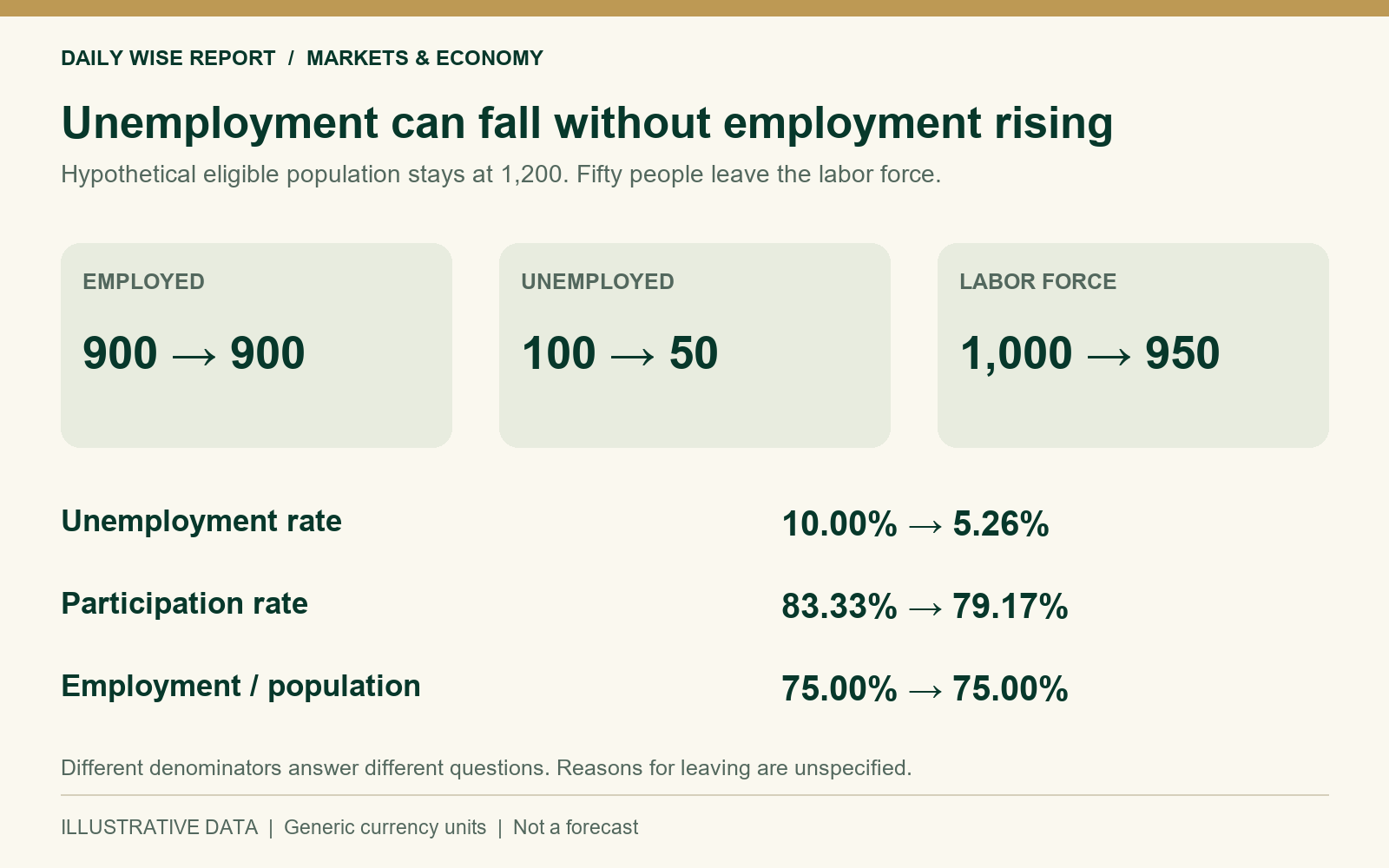
The rate falls without a new job
The model assumes 50 unemployed people move outside the labor force. Employment remains exactly 900. The unemployment calculation changes from 100 ÷ 1,000 to 50 ÷ 950. The resulting decline from 10% to about 5.26% is mathematically consistent with no employment increase.
Participation falls as the labor force shrinks relative to the unchanged population. Employment remains 900 out of 1,200 people, so the employment-to-population ratio stays at 75%.
Leaving the labor force has more than one explanation
The example leaves the reason for the 50 departures unspecified. They could involve education, retirement, caregiving, illness or discouragement, with different consequences for the people involved.
A fall in participation therefore is not automatically evidence of one particular economic problem. Its consequences depend on who changes status and why. A household losing labor income faces different pressures from someone entering an already-planned retirement.
Job counts do not describe every aspect of work
The table counts people, not hours, earnings or job quality. A person can remain employed while hours are cut, so unchanged employment does not establish unchanged income. Conversely, longer hours can increase output without an additional person entering employment.
A survey estimate also has a reference period and measurement uncertainty. One movement cannot, by itself, establish a durable labor-market trend or determine what a central bank will do next.
Scope and limitations
All numbers are invented and rounded. No country’s latest employment conditions are represented. The analysis explains denominators and interpretation limits, without predicting wages, recessions or market performance.
Related reading
GDP Growth Can Look Stronger Than the Economy Feels
Why a Central Bank Rate Change Reaches People at Different Times
Leave a Reply