A Lower Grocery Unit Price Can Still Cost More per Portion Used
Package price, price per kilogram and the cost of the amount actually consumed are different comparisons. Waste can change the result.
A larger food package can cost less per kilogram and still require more cash at checkout. If some food goes unused, the cost per kilogram actually eaten rises. The package price, shelf unit price and cost of consumed food each measure a different quantity.
Comparing packages by weight
The US National Institute of Standards and Technology explains unit pricing as expressing a product’s cost per unit of measure. This makes different package sizes easier to compare. Its discussion also describes downsizing at an unchanged package price, sometimes called shrinkflation.
Our example uses identical imaginary food, equal quality and the same weight basis. The calculation converts grams into kilograms before dividing the price by the quantity.
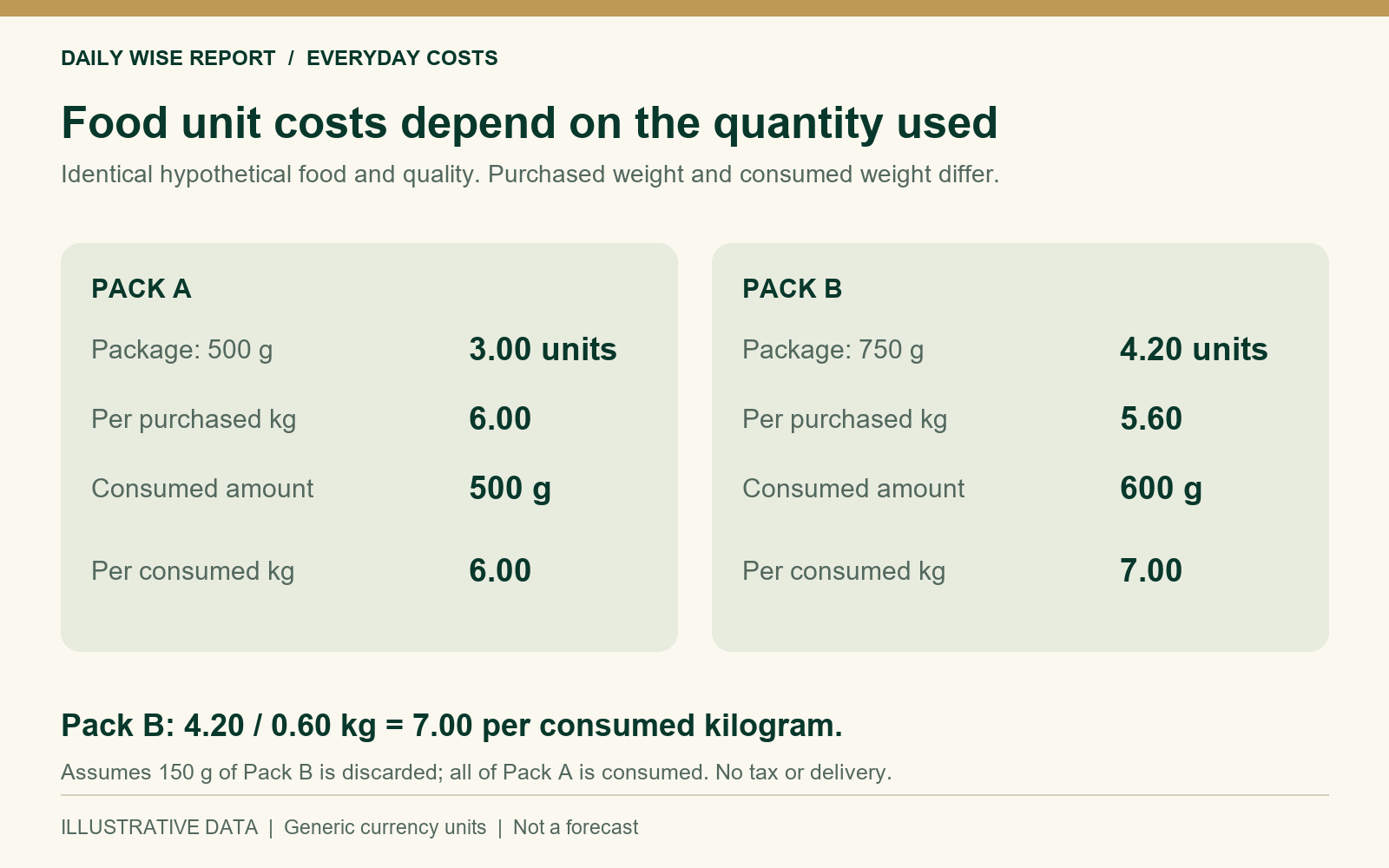
| Measure | Pack A | Pack B |
|---|---|---|
| Purchased quantity | 500 g | 750 g |
| Package price | 3.00 | 4.20 |
| Price per purchased kilogram | 6.00 | 5.60 |
| Amount consumed in this scenario | 500 g | 600 g |
| Cost per consumed kilogram | 6.00 | 7.00 |
Unused quantity changes the denominator
Pack B costs 4.20 ÷ 0.75, or 5.60 per purchased kilogram. If 150 grams are discarded, only 0.60 kilograms are consumed. Dividing the unchanged 4.20 cost by that smaller amount gives 7.00 per consumed kilogram.
With all 500 grams of Pack A consumed, its cost stays at 6.00 per kilogram. Pack B has a lower shelf unit price but costs 7.00 per kilogram eaten in this scenario. Using all of Pack B would change that result.
A smaller package can hide a price increase
In a separate example, a package shrinks from 500 to 450 grams while remaining priced at 3.00. The purchased unit price rises from 6.00 to about 6.67 per kilogram, an increase of 11.11%. The quantity fell 10%; its reciprocal price effect is not exactly 10%.
The calculation assumes the contents stay the same. Concentration, preparation requirements and usable yield could change the comparison; equal weight alone says little about nutrition or servings.
Unit price leaves some costs unresolved
Storage space, preparation time and the ability to use leftovers are outside the table. A bulk purchase also commits more cash upfront, which may matter even when every gram is eventually used. No actual household waste rate is asserted here.
Scope and limitations
All prices and quantities are invented. Label units and pricing rules vary by country. The analysis compares quantities and assumptions; it does not recommend a package size, diet, brand or shopping strategy.
Related reading
Free Delivery Can Still Leave a Larger Checkout Total
An Annual Subscription Discount Depends on How Long the Service Is Used
Leave a Reply