Why a Stock Index Can Rise While Most of Its Members Fall
The number of rising companies and their weights are different measurements. A few large constituents can dominate a weighted index’s result.
A weighted stock index can rise while most of its companies fall. A count gives each company one vote; the index gives some companies much more influence than others.
Weights determine contributions
Investor.gov’s index-fund explanation describes how market-cap-weighted indexes give larger companies a greater share, while other indexes use different weighting methods. An index’s construction therefore matters when interpreting what its movement represents.
The fictional index below has four constituents and fixed starting weights for one period. It measures price changes only, with no dividends, fees, rebalancing or membership changes.
| Company | Starting weight | Price return | Index contribution |
|---|---|---|---|
| A | 60% | +10% | +6.0 percentage points |
| B | 20% | −5% | −1.0 percentage point |
| C | 10% | −5% | −0.5 percentage points |
| D | 10% | −5% | −0.5 percentage points |
| Total | 100% | Three of four fall | +4.0 percentage points |
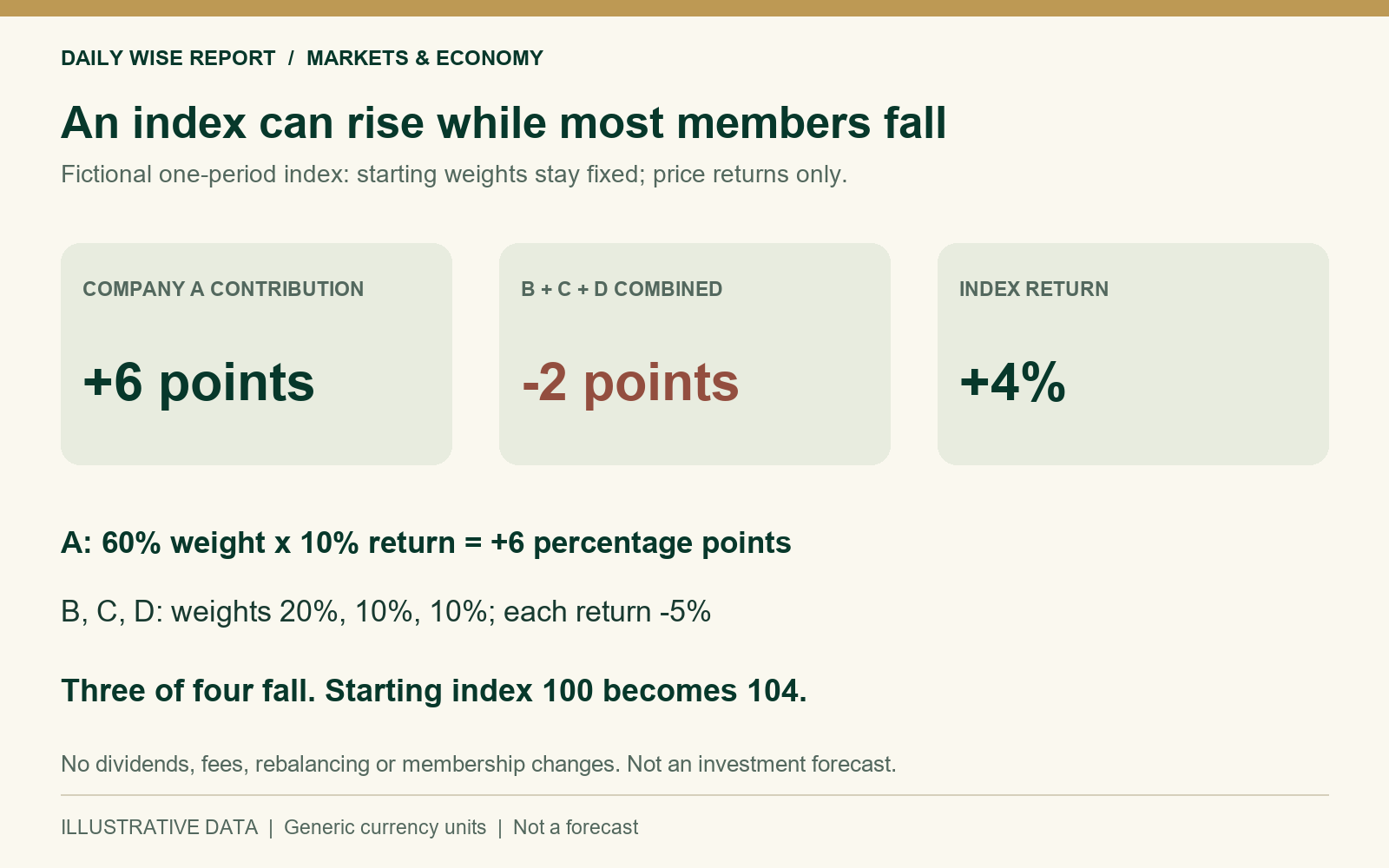
Company A contributes 0.60 × 10%, or 6 percentage points. The other companies contribute minus 2 points together. The combined index return is therefore 4%. A starting index value of 100 becomes 104.
Giving each company a 25% weight
At equal starting weights of 25%, the same returns give (10% − 5% − 5% − 5%) ÷ 4, or −1.25%. The index moves from 100 to 98.75. Changing the weighting method changes this result without changing any company’s return.
The weights describe the index’s exposure. Neither calculation identifies a company that represents a typical household or establishes which portfolio would suit a reader.
Concentration can amplify both directions
A large constituent also has more influence when it falls. In a separate hypothetical period, a 10% loss at a 60% starting weight would subtract 6 percentage points before the other companies’ movements are included.
Companies in the same industry, or exposed to the same demand shock, may share economic risks. The number of holdings alone gives no measure of that independence or of how influence is distributed.
The return label still matters
A price index omits cash distributions. A total-return measure treats distributions according to its methodology. Fund costs, tracking differences and investor cash-flow timing introduce further differences between an index number and a person’s realized outcome.
Scope and limitations
All companies and weights are fictional. No current index concentration is asserted, and no return is forecast. The comparison explains measurement; it does not recommend an index, fund or weighting strategy.
Related reading
Why Fixed-Rate Bond Prices Can Fall When Market Yields Rise
Leave a Reply