Free Delivery Can Still Leave a Larger Checkout Total
A delivery charge is only one part of an order. Basket size and other fees determine whether reaching a threshold changes the amount actually paid.
Removing a delivery fee can leave a larger checkout total if the basket grows enough to qualify for the waiver. The extra goods and any remaining fees both affect what is paid.
Isolate the fee being waived
A May 2026 Federal Trade Commission consumer notice discusses the importance of understanding the total delivery price, including fees. That notice concerns US delivery practices and a request for public input; it does not establish a worldwide rule or a finding about a specific provider.
Our imaginary offer waives a four-unit delivery charge when the basket reaches 35. A separate service charge of two remains in every case. There are no taxes, tips, membership charges or other adjustments in the model.
| Scenario | Basket | Delivery | Service | Final total |
|---|---|---|---|---|
| Original order | 32 | 4 | 2 | 38 |
| Add 3 to reach threshold | 35 | 0 | 2 | 37 |
| Add 8 and exceed threshold | 40 | 0 | 2 | 42 |
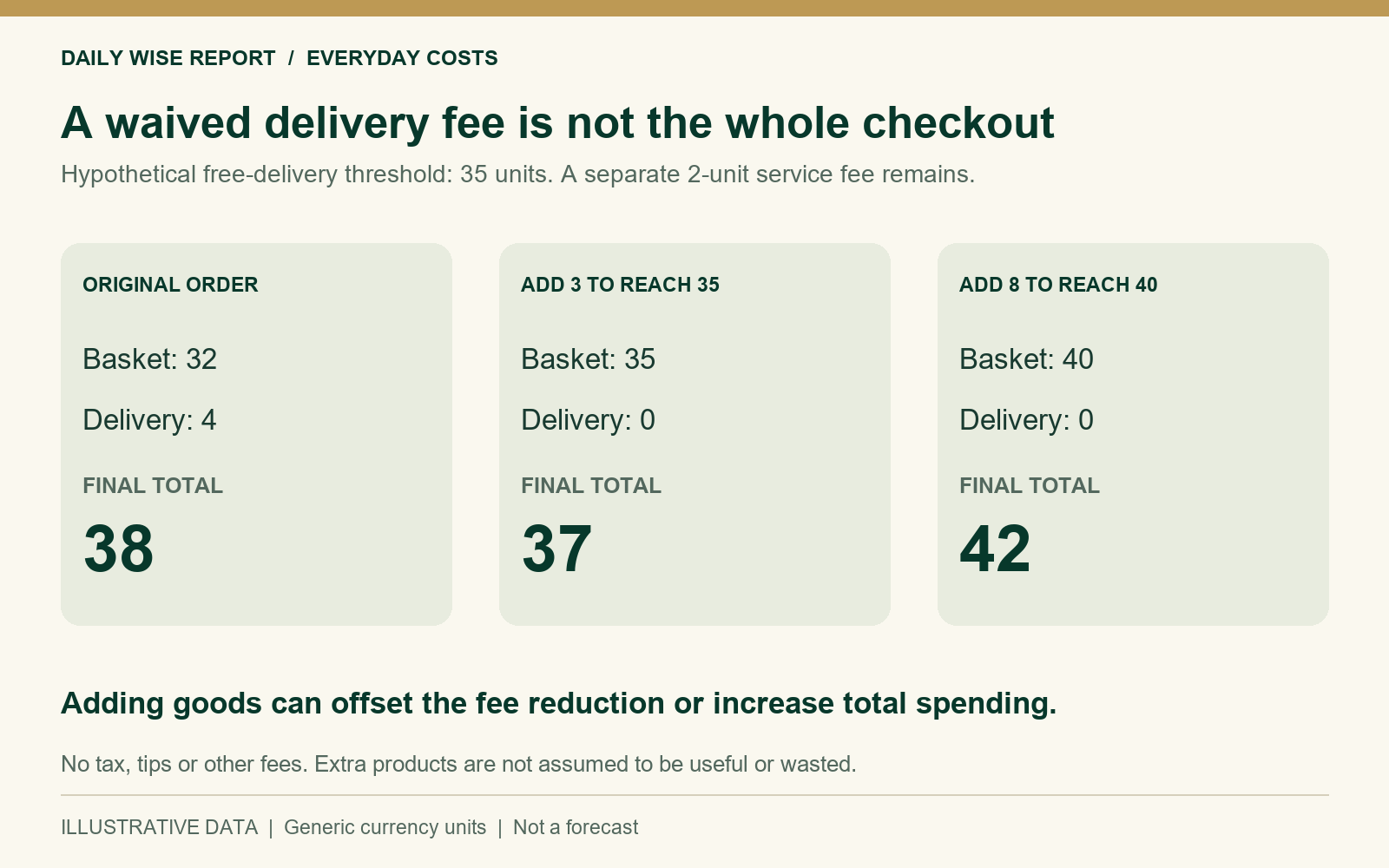
A four-unit waiver can produce only a one-unit reduction
The second basket adds three in goods and removes four in delivery charges. The net change is minus one, from 38 to 37. Calling the checkout payment four cheaper would omit the extra three spent on goods.
The third basket adds eight in goods and removes four in delivery charges, raising the total from 38 to 42. The waiver stays at four in both qualifying orders; the extra goods account for their different totals.
What happens to the added goods
If the added items replace a purchase that would have happened later at the same price, the broader household-spending comparison may differ from this single checkout. If they are not used, the payment still occurred without providing the expected consumption.
Whether the extra items are useful depends on what the household would otherwise buy and use. These figures assign them no personal value and do not establish why they were added.
Other line items can move too
A real service charge could vary with the basket rather than remain fixed. Item prices, promotional exclusions and the amount counted toward a threshold may also differ. A comparison with in-store shopping would need an equivalent basket and the relevant travel or collection costs.
A membership with delivery benefits adds another time period and payment schedule. Allocating its fee across orders depends on the assumed number of orders; a zero delivery line alone cannot calculate its value.
Scope and limitations
The offer is invented and all fees are explicit assumptions. No platform, retailer or promotion is ranked. This analysis explains checkout arithmetic without recommending additional purchases or a delivery service.
Related reading
A Lower Grocery Unit Price Can Still Cost More per Portion Used
An Annual Subscription Discount Depends on How Long the Service Is Used
Leave a Reply