An Annual Subscription Discount Depends on How Long the Service Is Used
A lower monthly equivalent can require a larger upfront payment. The relevant comparison changes if access is needed for only part of the year.
An annual subscription may quote a lower monthly equivalent while collecting the full price upfront. Total cost depends on how many monthly payments it replaces and what refund is available if use ends early.
What is due upfront
The US Federal Trade Commission’s subscription explanation describes renewals and the possibility that a promotional price changes later. The relevant conditions are part of the comparison. The article below does not assume any particular cancellation right or renewal law.
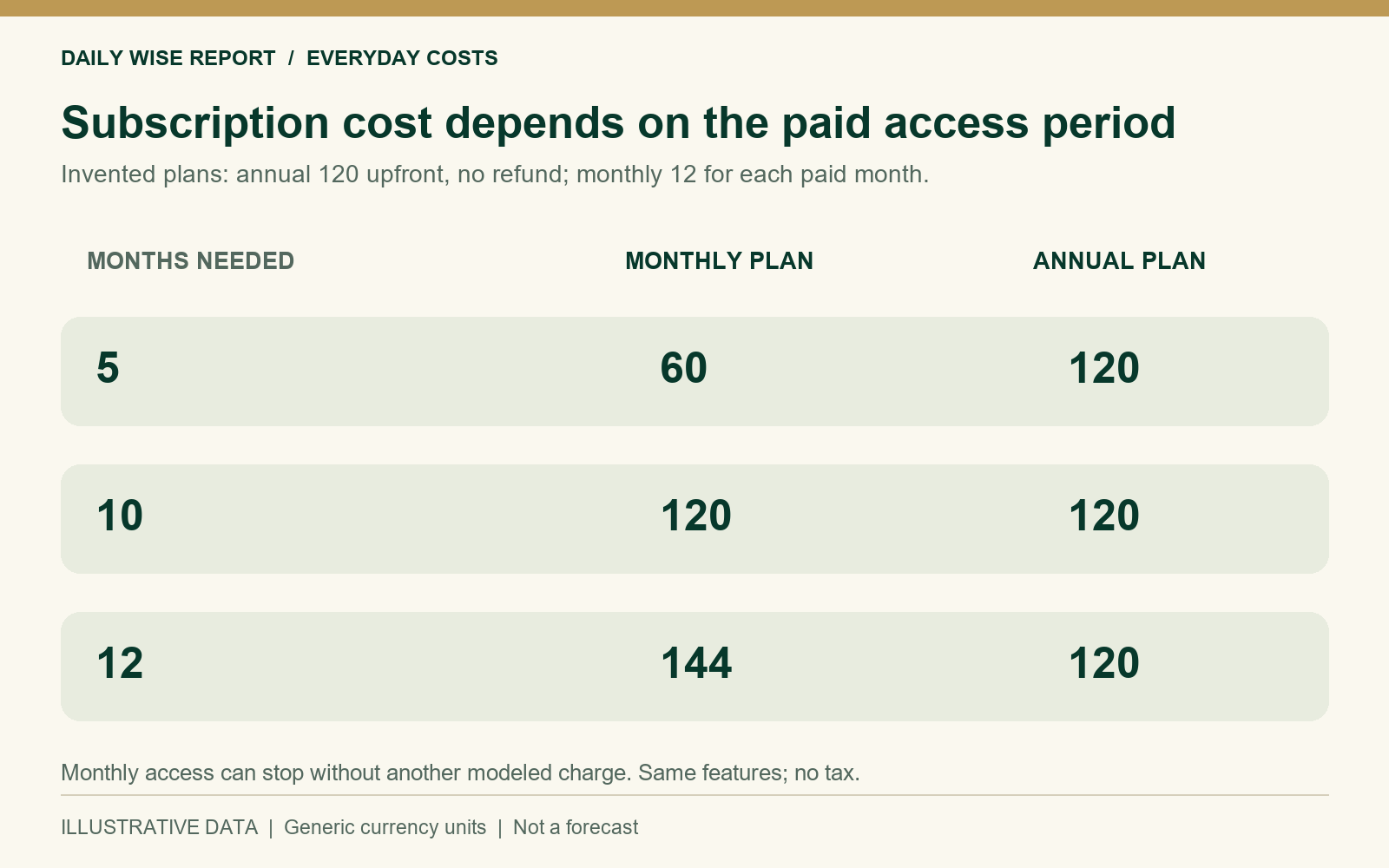
Our fictional service has two plans. Annual access costs 120 upfront, with no refund in this model. Monthly access costs 12 per paid month, can stop after the stated number of months without an additional modeled charge, and offers the same features.
| Access period needed | Monthly plan total | Annual plan total |
|---|---|---|
| 5 months | 60 | 120 |
| 10 months | 120 | 120 |
| 12 months | 144 | 120 |
The assumed use period changes the result
Over twelve months, the annual plan costs 24 less, a reduction of approximately 16.67% relative to 144. Over five months, the annual commitment costs 60 more than five monthly payments. The service did not change price between these comparisons; the assumed duration changed.
The annual price divided by twelve is ten per month. All 120 is still due at the start under this plan, so that equivalent differs from an actual monthly collection of ten.
Unused access and refund terms matter
Stopping after five months leaves the annual buyer with a 120 cost and no refund in this model. That works out to 24 per month used, a measure of actual use rather than the quoted monthly equivalent.
A refundable or prorated annual agreement would require a different calculation. So would a monthly contract with a minimum term or an exit charge. The word monthly alone does not establish those conditions.
Renewal adds a separate uncertainty
An initial twelve-month price does not determine the next renewal price. Additional services or overlapping subscriptions could also change total recurring spending. No future price change or cancellation behavior is predicted here.
Real plans may differ in features, access restrictions or reliability. The calculation assumes those features are identical so that the payment periods can be compared.
Scope and limitations
All charges and conditions are invented. Rules and agreements differ internationally. This article explains duration, utilization and cash timing without recommending a billing cycle or a subscription decision.
Related reading
Free Delivery Can Still Leave a Larger Checkout Total
A Cheaper Appliance Purchase Can Have a Higher Five-Year Energy Cost
Leave a Reply