How a pending card payment changes your available balance
A card reservation can reduce the money available for another payment before the final charge posts. The order of events explains why the figures move differently.
In a hypothetical hotel payment, a bank account has 600 currency units when the hotel requests a 150-unit reservation on a debit card. The posted balance stays at 600, while the amount available for another payment falls to 450. The hotel has not yet collected its final bill in this example.
The gap comes from an authorization hold. It sets aside part of the account balance while a card payment is pending. Monzo describes this process for its UK accounts: money is reserved until the merchant collects it or the bank releases the reservation. Its published timing belongs to that service; other banks can have different arrangements.
Two figures can describe the same account
A posted or ledger balance records transactions that have completed the bank’s posting process. An available balance can also reflect money reserved for pending payments. Names and calculations vary, so an app’s label needs the explanation supplied by that bank.
For a simple account with no deposit holds or other adjustments, the calculation might be: available balance equals posted balance minus outstanding card reservations. The example here uses that rule throughout. It excludes overdraft facilities, fees, currency conversion and interest.
Chase’s explanation of transaction posting gives a US example of pending transactions affecting an available balance before they post. It also notes that some payments cannot be shown as pending. The description applies to Chase accounts; the labels and processing rules belong to that provider.
A smaller final bill releases part of the reservation
Suppose a separate grocery payment of 40 posts while the hotel’s 150-unit hold remains in place. The posted balance falls to 560. Subtracting the reservation leaves 410 available.
| Stage | Posted balance | Outstanding hold | Available balance |
|---|---|---|---|
| Opening position | 600 | 0 | 600 |
| Hotel reserves 150 | 600 | 150 | 450 |
| Grocery payment of 40 posts | 560 | 150 | 410 |
| Hotel settles for 120; full hold removed | 440 | 0 | 440 |
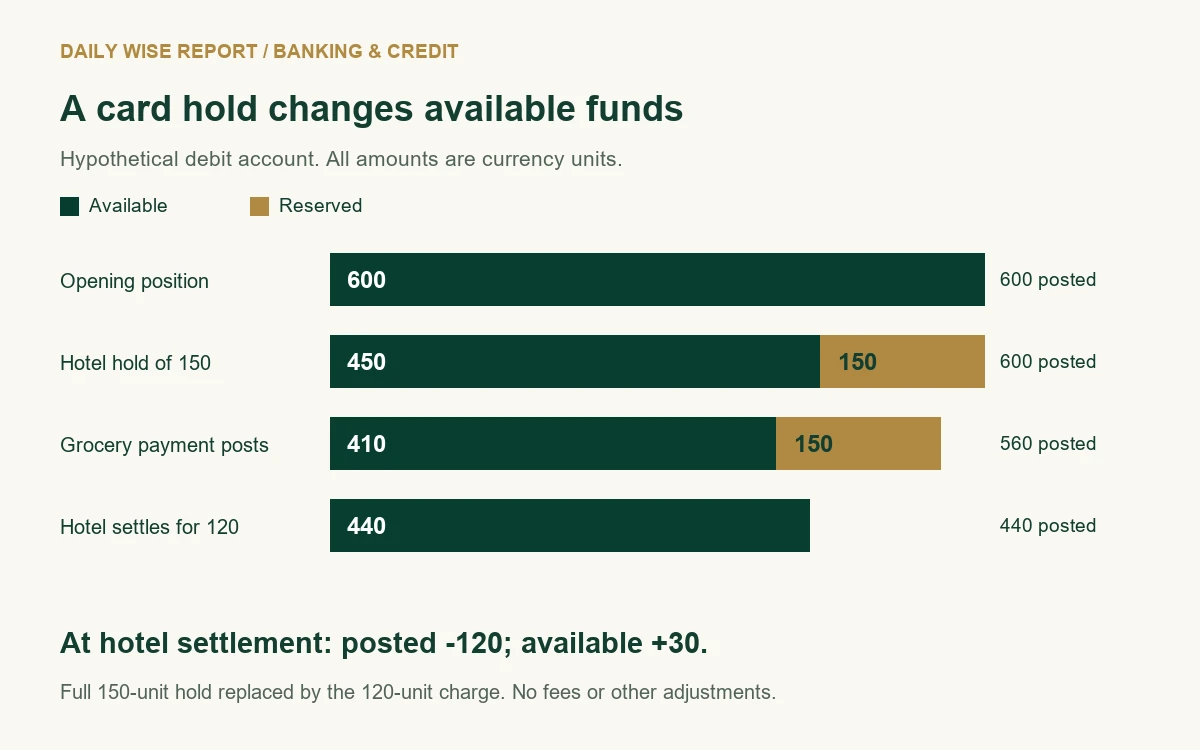
At settlement, assume the bank removes the full 150-unit hold and posts the final hotel charge of 120 as one matched change. The posted balance falls from 560 to 440. Available funds rise from 410 to 440, because releasing 150 and deducting 120 leaves 30 more available than before.
That 30-unit increase comes from the difference between the reservation and the final bill. The account has received no new deposit. A refund would be a separate credit reversing all or part of a payment that had already posted.
The hotel amounts are invented. The model assumes a clean replacement of the reservation by the final charge. Actual screens can update in stages, so a pending entry and a posted entry may briefly appear together. Their appearance alone cannot establish whether there is a duplicate debit.
The amount and the release time can differ
An authorization may be based on an estimate when the final bill is not yet known. Chase’s explanation of debit card holds describes this possibility, including a reservation that exceeds the eventual purchase amount. A reservation for 150 therefore does not establish that the final charge will be exactly 150.
A release time is also a separate question from a refund time. A bank can release money that was reserved without recording a refund, since that reserved amount may never have become a posted payment. The account’s rules and the merchant’s processing determine how the entry is handled. This article assumes no universal release deadline.
Other payments can make the gap costly
While only 410 is available in the example, a separate attempted payment of 450 may be declined. The precise outcome depends on the bank’s authorization rules and any agreed facility. The posted figure of 560, taken on its own, does not describe the reservation already affecting that decision.
An account can also face a shortfall when payments arrive in a different order from the one its holder expected. A delayed purchase or an unpaid bill can create further costs. Whether a bank may pay an overdraft or charge a fee depends on the account and applicable law; an authorization hold does not by itself establish that a fee is due.
The US Consumer Financial Protection Bureau describes an overdraft as a bank paying a transaction when the account lacks sufficient funds. Every balance in the table remains positive, so it contains no overdraft. No fee amount or legal entitlement is inferred from this example.
What the account screen leaves unresolved
Pending amounts help explain current restrictions on spending. Posted history explains completed account entries. Neither supplies a complete forecast of later payments: an unpresented cheque or a payment the bank has not yet received can be absent from the current view.
The calculation also changes when an account has funds held against a deposit, an overdraft facility or other adjustments. For a credit card, pending purchases can reduce available credit. This involves the card’s credit limit, so the deposit-account figures shown here do not apply. The four rows cannot be transferred unchanged to those arrangements.
Sources and scope
The linked Monzo and Chase pages describe particular UK and US services. The CFPB page provides a US explanation of overdrafts. They support the distinctions discussed here, without establishing identical labels, release times or legal protections in other countries. All numerical balances are hypothetical, and no account or payment provider is recommended.
Related reading
Cash Flow Is Not Net Worth: Why Timing Can Create a Shortfall
Why a Bank Account Fee Waiver Can Disappear from One Month to the Next