When a smaller pack raises the price per unit
An unchanged shelf price can buy less product. Comparing an equal quantity shows the increase, while the amount paid at checkout can tell a different story.
A hypothetical food pack changes from 500 grams to 450 grams, while its shelf price stays at 4.50 currency units. A shopper pays the same amount for one pack and receives 50 grams less. Replacing a fixed amount of food now costs more.
This is a quantity change that raises the price per unit. It is often called shrinkflation. The US Government Accountability Office describes product downsizing as a reduction in quantity without a matching price reduction. Its research also notes that subtle packaging changes can make the change difficult to notice.
The comparison needs an equal quantity
The original pack costs 4.50 divided by 500, or 0.009 per gram. Multiplying by 100 gives 0.90 per 100 grams. The smaller pack costs 4.50 divided by 450, or 1.00 per 100 grams.
These figures assume identical food quality and composition, with no taxes, discounts or delivery charges. The pack price alone leaves out the change in the amount supplied.
| Pack | Quantity | Pack price | Price per 100 g | Unit-price change |
|---|---|---|---|---|
| Original | 500 g | 4.50 | 0.90 | Baseline |
| Smaller, same price | 450 g | 4.50 | 1.00 | +11.1% |
| Smaller, matching price cut | 450 g | 4.05 | 0.90 | 0% |
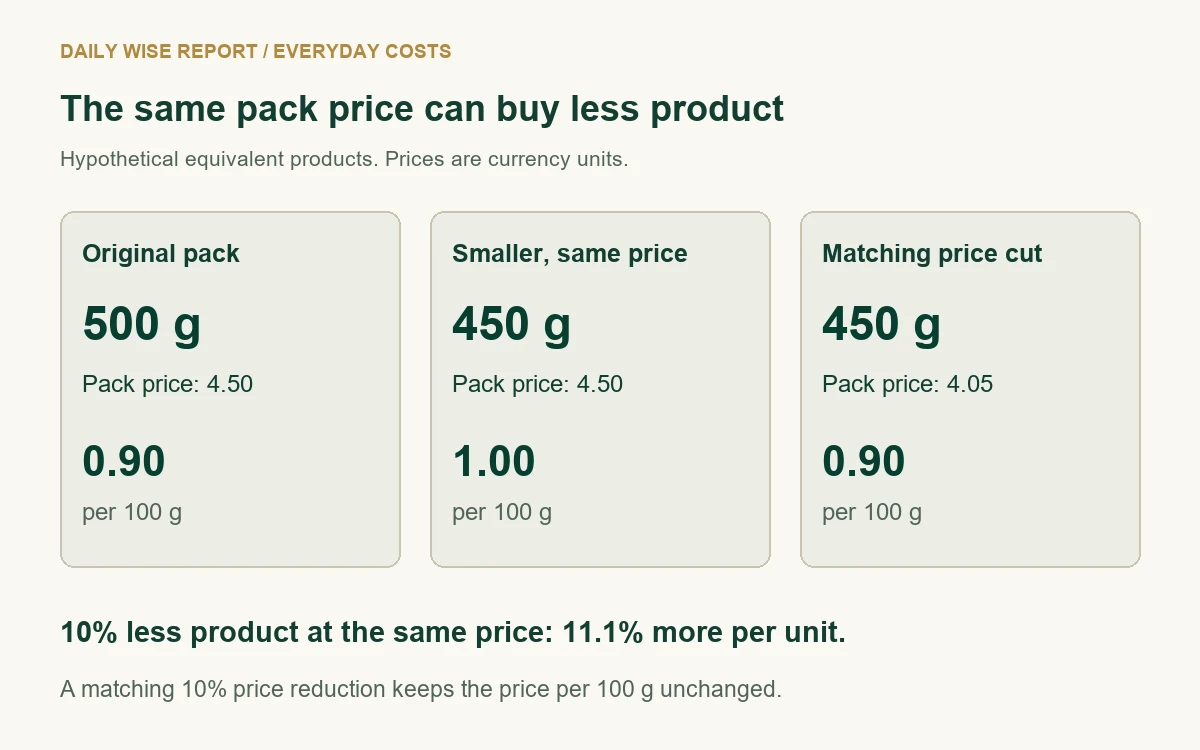
A 10% size cut produces an 11.1% unit-price increase
The quantity falls by 50 divided by the starting 500 grams, which is 10%. The unit price rises by 0.10 divided by its starting level of 0.90, which is approximately 11.1%. The percentages have different denominators.
With the pack price held constant, the unit-price multiplier is the original quantity divided by the new quantity. Here it is 500 divided by 450, or about 1.111. A separate example reducing a 500-gram pack to 400 grams at the same price would raise the unit price by 25%, even though the quantity reduction would be 20%.
The final row shows a different outcome. Cutting the pack price from 4.50 to 4.05 matches the 10% quantity reduction, so the price for an equal quantity stays unchanged.
The checkout bill depends on how much is used
Suppose a household uses exactly 3,000 grams of this food in a period. At the original size, six packs supply that amount for 27.00. At the smaller size and unchanged 4.50 pack price, an equal quantity has a proportional cost of 30.00.
Packs cannot necessarily be bought in fractions. If the household starts with none and can buy only whole 450-gram packs, it needs seven packs. That checkout costs 31.50 and supplies 3,150 grams, leaving 150 grams after the assumed consumption.
The 150 grams can carry into the next period if it remains usable. It is not automatically waste. If it spoils or is discarded, the amount actually consumed has a higher cost than a calculation that treats every gram purchased as useful. If consumption falls instead, the household may keep its spending near the old level while receiving less food.
These alternatives explain why a household’s checkout total need not rise by exactly 11.1% in the first period. The unit-price comparison holds quantity constant; the cash paid for whole packs also depends on opening supplies and leftover stock.
How a smaller pack enters a price index
The US Bureau of Labor Statistics explains that the CPI accounts for product size changes. Comparing only the unchanged pack price would miss the increase in the cost of a constant quantity. The statistical treatment aims to capture that quantity effect.
Statistics Canada describes a similar quantity adjustment in its CPI explanation. A smaller amount at the same price is recorded as a price increase for an equivalent quantity. These references cover measurement in the US and Canada.
A noticeable change in one product also has a different scale from an economy-wide index. Its contribution depends on how much of the measured spending it represents and how other prices change. The hypothetical 11.1% increase here is a calculation for one pack comparison, not an inflation rate for food or for the economy.
Weight does not settle every comparison
A unit-price calculation is most informative when the units describe equivalent goods. A change in concentration, recipe or usable content can change what a given weight delivers. Comparing 100 grams of two different formulations does not establish that they provide the same amount of use.
Outer box dimensions are also different from net contents. A carton can change shape without changing the quantity inside. Conversely, similar-looking packaging can contain a different amount. The calculation requires the product quantity, not an estimate from the space a box occupies.
Household needs set another limit. A smaller pack may reduce the initial cash required or the amount left unused, depending on its price and how much is consumed. In the matching-price-cut example, both the quantity and the initial outlay fall by 10%, while the unit price is unchanged. That trade-off differs from the same-price smaller pack.
Sources and scope
The GAO, BLS and Statistics Canada references support the definitions and measurement discussion. Every price, pack size and household quantity used in the arithmetic is invented for illustration. The examples assume comparable quality and exclude promotional conditions. No brand or purchasing choice is recommended.
Related reading
A Lower Grocery Unit Price Can Still Cost More per Portion Used
Percent vs Percentage Points: Why the Same Change Can Sound Very Different