Percent vs Percentage Points: Why the Same Change Can Sound Very Different
A rate can rise by one percentage point and by 25% at the same time. The denominator explains the difference.
A move from 4% to 5% is an increase of one percentage point. Dividing that increase by the starting 4% gives a relative rise of 25%. The two descriptions use different bases for the same movement.
Two descriptions, one movement
The UK’s Office for National Statistics style guide distinguishes the difference between two percentages from a percentage change relative to a starting value. That distinction matters whenever the quantity being compared is already a rate.
| Measure | Calculation | Result |
|---|---|---|
| Starting and ending rate | 4% to 5% | One movement |
| Percentage point change | 5 − 4 | +1 percentage point |
| Relative percentage change | (5 − 4) ÷ 4 × 100 | +25% |
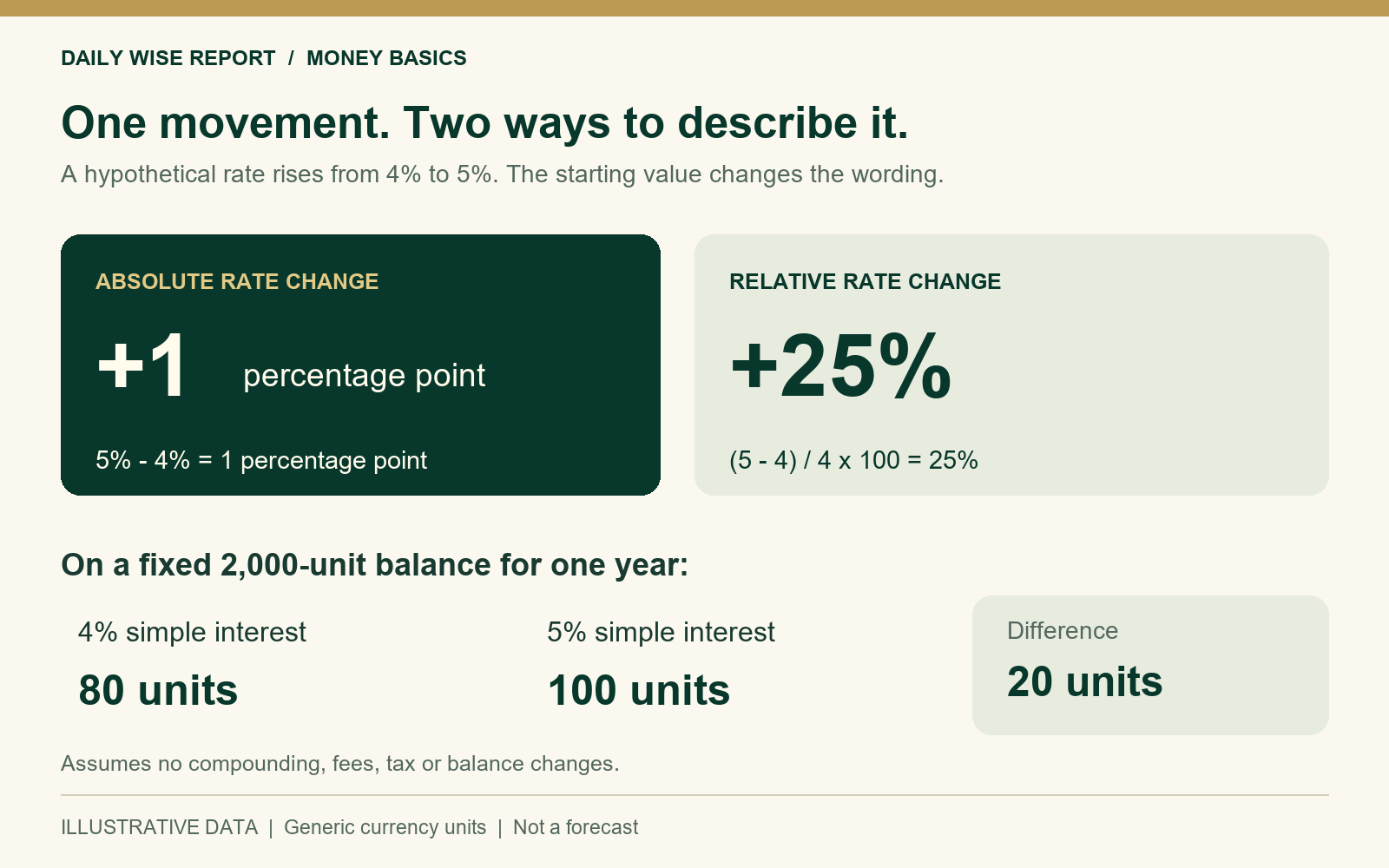
The 25% describes the increase relative to the original 4% rate; the new rate is 5%, not 29%. A small starting rate makes the relative change look larger than the absolute difference.
What that means in money
For an imaginary balance of 2,000 currency units, simple annual interest of 4% would be 80 units. At 5%, it would be 100. The difference is 20 units, which is 25% of the original 80-unit interest amount but just 1% of the balance.
This illustration assumes a fixed balance for exactly one year, no compounding, no fees and no taxes. A loan with monthly repayments has a changing balance, so multiplying the opening balance by a rate difference does not calculate the actual annual increase in its payment burden.
Why losses and recoveries are asymmetric
The starting value also explains why equal percentage changes do not cancel. A hypothetical value of 100 that falls 20% becomes 80. A subsequent 20% increase takes it to 96, because the gain is calculated on 80. Returning from 80 to 100 requires a 25% increase.
The loss and recovery use different starting amounts, which is why adding their percentages misses the result. The same arithmetic applies to account values, prices and sales figures, without predicting that a recovery will occur.
What a comparison can leave out
A rate alone omits the amount of money exposed to it and the length of time involved. Moving from 1% to 2% doubles the rate, but moving from 10% to 11% also adds one percentage point. The relative changes differ even though their absolute rate differences match.
Comparisons become less informative when the starting value is zero or negative. A percentage increase from zero is undefined under the usual formula. Moving from a loss to a profit also needs the underlying amounts for context; a dramatic percentage can obscure more than it reveals.
Limits of this analysis
These examples explain numerical language, not the attractiveness of a financial product. Contract terms, timing and the amount involved determine the practical effect. All figures are hypothetical and rounded only where stated.
Leave a Reply