Why a Small Fixed Fee Can Be Expensive on a Small Balance
The same charge can have very different effects depending on the balance, transaction size and length of time.
A three-unit fee takes a larger share of a small balance than a large one. Repeating it monthly adds another cost dimension: the total paid over time. Both the cash charge and its percentage of the amount involved matter.
The denominator changes the burden
Consider an imaginary account charging three units a month. That is 36 units over twelve months. Dividing this annual total by a reference balance gives a simple way to illustrate the scale of the charge.
| Reference balance | Annual fixed fees | Fees ÷ balance |
|---|---|---|
| 300 | 36 | 12% |
| 1,200 | 36 | 3% |
| 6,000 | 36 | 0.6% |
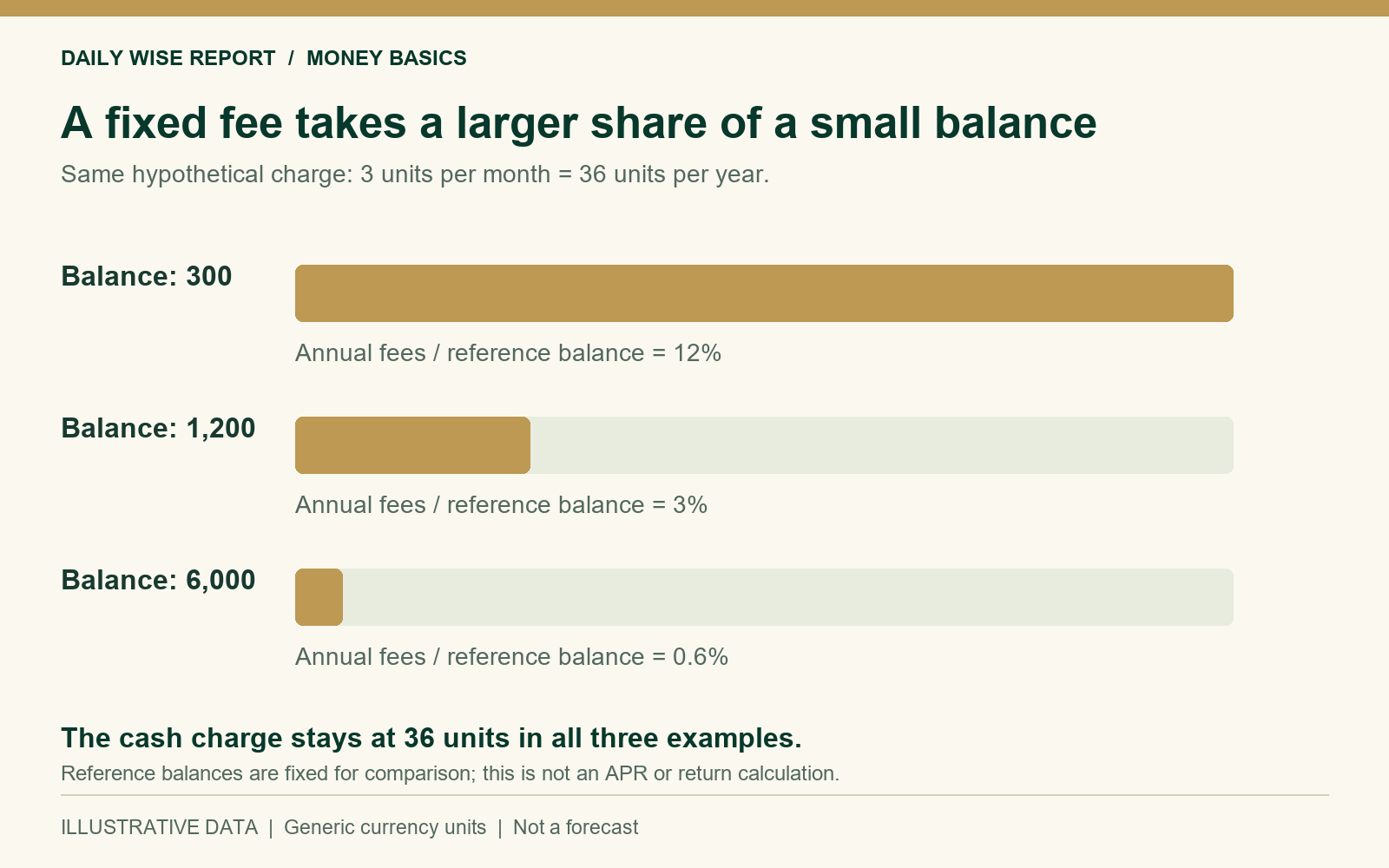
The charge stays at 36 in each case, taking a larger proportion of the smaller reference balance. Those balances are comparison bases, not projected year-end amounts. Without deposits or income, the fee deductions would reduce the account balance.
Transaction size matters too
A two-unit charge on a 20-unit transfer equals 10% of the transfer amount. The same charge on a 200-unit transfer equals 1%. If a hypothetical conversion service adds a 1% charge as well, total explicit costs become 2.20 units and 4 units respectively, assuming both charges are paid separately.
The larger transfer has a lower percentage cost but a higher cash charge. Neither observation establishes which transaction suits a particular person. Availability, urgency, exchange rates and contractual minimums can change the comparison.
Visible fees may be only part of the cost
In an investment context, the US Securities and Exchange Commission’s Investor.gov bulletin on fees and expenses explains that costs can be transactional or ongoing, and that money deducted in fees is no longer available to earn returns. This is a general mechanism; the bulletin’s US regulatory context does not establish rules for other countries.
A service with no subscription charge may still have an exchange-rate spread, a withdrawal charge or a minimum fee. The disclosed terms and actual use determine which costs apply.
The effect of repetition
Twelve transactions with a two-unit fee cost 24; one costs two. Combining them might cut the fee total but also delay a payment or require more money to be held in one place. The arithmetic covers frequency alone.
Over longer periods, it is also misleading to multiply an annual percentage by years and call the result a precise reduction in final wealth. Changing balances, returns and the timing of deductions affect the outcome. Fixed charges and percentage charges behave differently as the amount changes.
Limits of this analysis
All examples use imaginary charges and generic currency units. They exclude tax and assume the stated fees apply exactly as described. They are not provider comparisons, product endorsements or forecasts.
Related reading
Emergency Funds and Predictable Bills Solve Different Problems
Leave a Reply