Emergency Funds and Predictable Bills Solve Different Problems
An annual bill can arrive infrequently without being unexpected. Separating timing from uncertainty changes the analysis.
Cash set aside for an annual insurance bill already has a known claim on it. Money held for an unexpected repair covers an uncertain cost. A single account balance can contain both commitments.
Unexpected is different from infrequent
The US Consumer Financial Protection Bureau describes an emergency fund as money set aside for unplanned expenses or financial emergencies. Its examples include repairs and loss of income. This definition helps distinguish uncertain events from recurring expenses that happen less often than monthly.
A bill due once a year is not a monthly payment, but its existence may still be predictable. Conversely, an urgent expense can remain uncertain even when its general category is familiar. A car is likely to need maintenance at some point; the date and cost of a sudden breakdown may be unknown.
One balance, two commitments
| Item | Amount | Role in this example |
|---|---|---|
| Cash currently held | 1,800 | Total visible balance |
| Annual bill due next month | 1,200 | Known commitment |
| Cash after that bill | 600 | Remaining capacity before other costs |
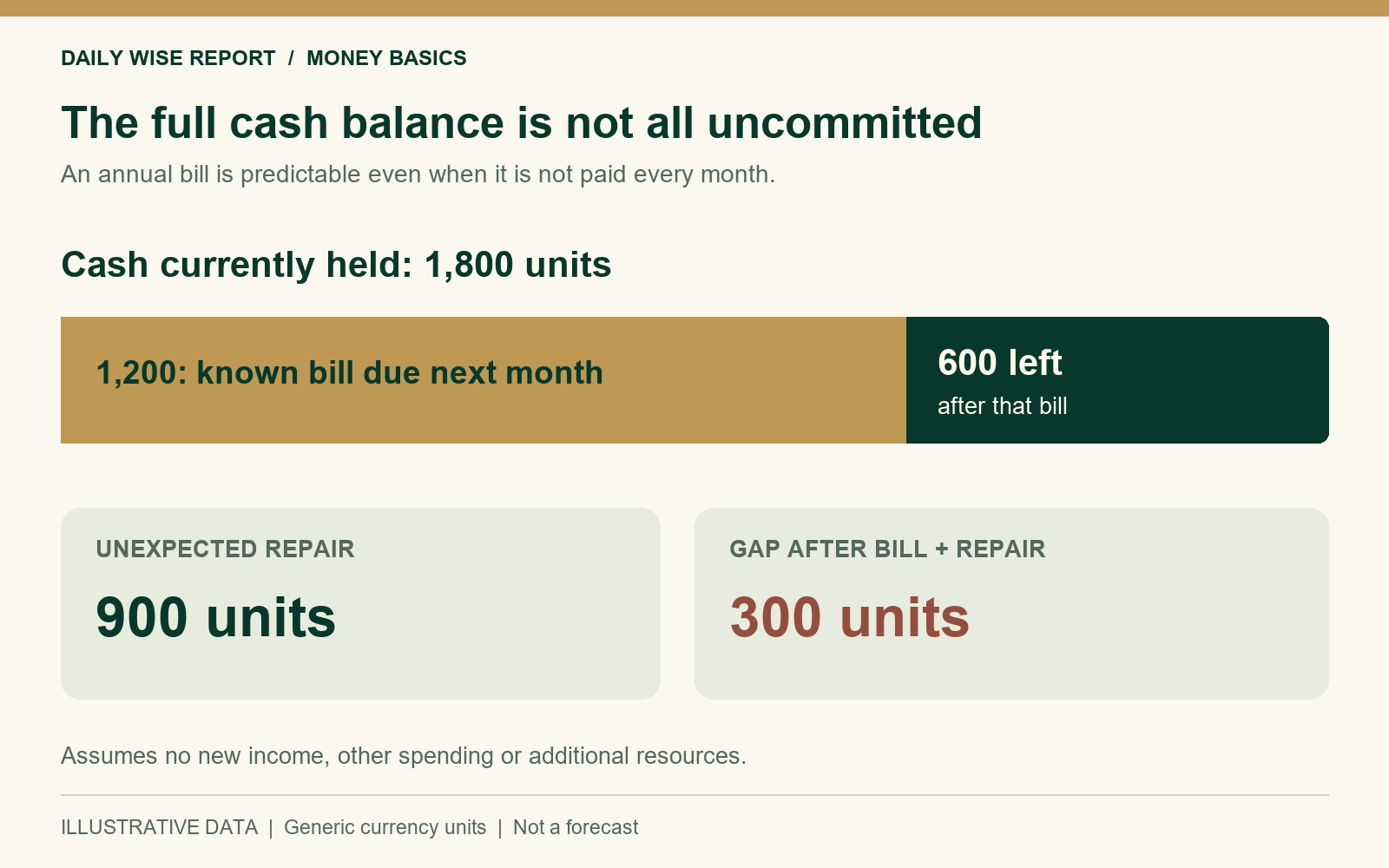
Calling all 1,800 units an emergency reserve would overlook the known 1,200-unit claim on that cash. After the scheduled bill, only 600 remains in this simplified example. If an unexpected 900-unit repair then arrives, the gap is 300 units before considering new income or other resources.
Moving money between named pots changes the labels while leaving the total balance unchanged. The labels can clarify existing commitments, but they cannot fill the 300-unit gap.
A monthly average does not fix a deadline
A 1,200-unit annual bill averages 100 per month over a full year. If it is due next month and no money has been accumulated, the household still needs the full 1,200 by that deadline.
That monthly average describes a rate of spending. The payment calendar shows the cash required on a particular date, where a shortfall may remain despite a manageable-looking average.
The cost of keeping cash available
Holding readily available cash can create a trade-off when prices rise faster than the amount earns. Committing a large balance to contingencies also leaves less for other uses. The financial cost depends on the alternatives actually available; an assumed investment return is not a guaranteed measure of that cost.
Access is another limitation. A balance that cannot be withdrawn immediately, or can only be withdrawn with a charge, differs from cash that is available when a bill falls due. Support from insurance or public benefits may also depend on eligibility and payment delays, which vary by jurisdiction.
Limits of this analysis
There is no universal reserve amount in this article. Income stability, existing commitments and access to support differ. The examples explain categories of uncertainty and timing; they do not prescribe a savings target or borrowing decision.
Related reading
Liquidity vs Value: Why an Asset May Not Pay an Immediate Bill
Leave a Reply