When a Pay Raise Buys Less: Understanding Real Income
A higher income figure can coexist with lower purchasing power. The result depends on prices, deductions and what is being compared.
A pay rise adds currency units to income. If prices rise faster, those units buy less despite the larger payment. Nominal income and purchasing power can therefore move in opposite directions.
Nominal and real measure different things
The UK’s Office for National Statistics explains deflators as a way to remove price changes when comparing economic values over time. Nominal values retain the prices of their period; real values express a comparison after a price adjustment. Applying that basic distinction to income requires a relevant measure of consumer prices, rather than automatically using a GDP deflator.
A raise that does not keep pace
In the following imaginary example, monthly income rises from 3,000 to 3,120 units, an increase of 4%. Over the same period, the cost of an unchanged illustrative basket rises by 6%.
| Measure | Before | After |
|---|---|---|
| Monthly income | 3,000 | 3,120 |
| Illustrative price index | 100 | 106 |
| Income in starting-period purchasing power | 3,000 | 2,943.40 |
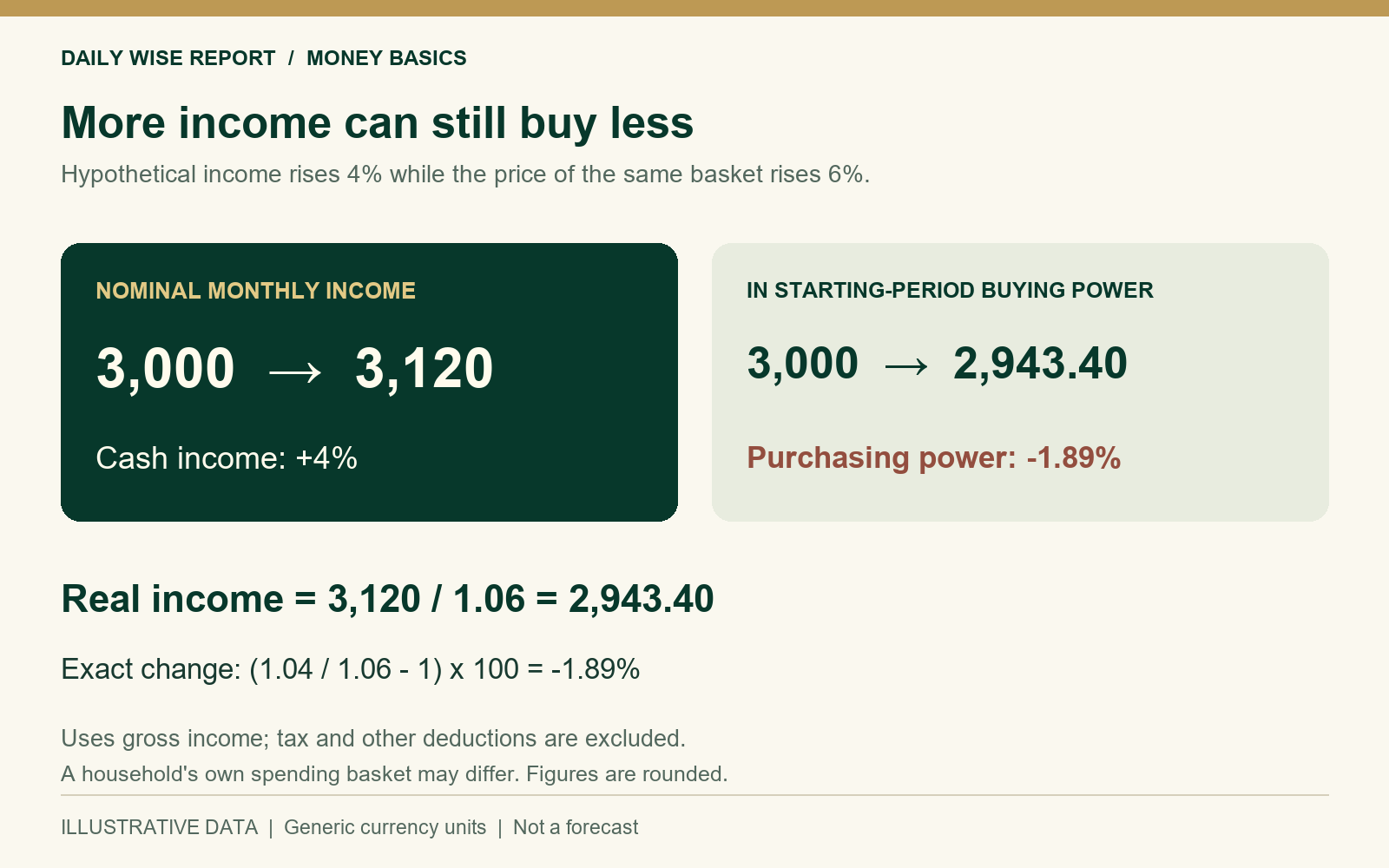
The last figure is 3,120 ÷ 1.06. Compared with the starting income of 3,000, that is a purchasing-power decline of about 1.89%. The exact percentage calculation is (1.04 ÷ 1.06 − 1) × 100. Subtracting 6% from 4% gives a rough approximation of minus 2%, rather than the exact result.
Gross pay is not disposable income
Deductions can also absorb part of a gross pay increase. Suppose they rise from 500 to 560 units: take-home pay moves from 2,500 to 2,560, up 2.4% against the 4% gross increase.
With the same hypothetical 6% price rise, the purchasing power of that take-home amount would decline by about 3.40%. These deductions are invented amounts, not an assumed tax schedule. Actual taxes, contributions and benefit interactions depend on local rules and personal circumstances.
Hours and household composition matter
More hours can increase monthly pay without raising the hourly rate, leaving less time available and potentially changing commuting or other work costs. Household income can also rise when another person starts earning, even if existing workers receive no raise.
Different spending patterns expose households to different price changes. The purchasing-power result applies to the stated basket, so a broad inflation index cannot make it an exact estimate for every reader.
Lower inflation does not reverse earlier increases
If a price index rises from 100 to 106 and then increases by 2%, it becomes 108.12. Prices are rising more slowly in the second period, but the level is still above both 100 and 106. A slower rate of inflation therefore does not itself restore the earlier purchasing power of an unchanged income.
Limits of this analysis
All calculations are illustrative, with rounded results. They describe measurement rather than predict wages, inflation or household outcomes. No employment, spending or investment decision is prescribed.
Related reading
Percent vs Percentage Points: Why the Same Change Can Sound Very Different
Leave a Reply