A Weaker Currency Creates Different Costs for Importers and Exporters
The direction of an exchange-rate quote matters. Foreign invoices, export prices and foreign-currency debts can respond differently to the same movement.
An exchange-rate change must specify both currencies and the direction of the quote. A weaker domestic currency can raise an importer’s bill while lowering the foreign price of an export whose domestic price stays fixed.
Define the quote first
The European Central Bank’s exchange-rate explainer describes how currency values influence international trade prices. That mechanism does not mean every retail price adjusts immediately or by the same proportion.
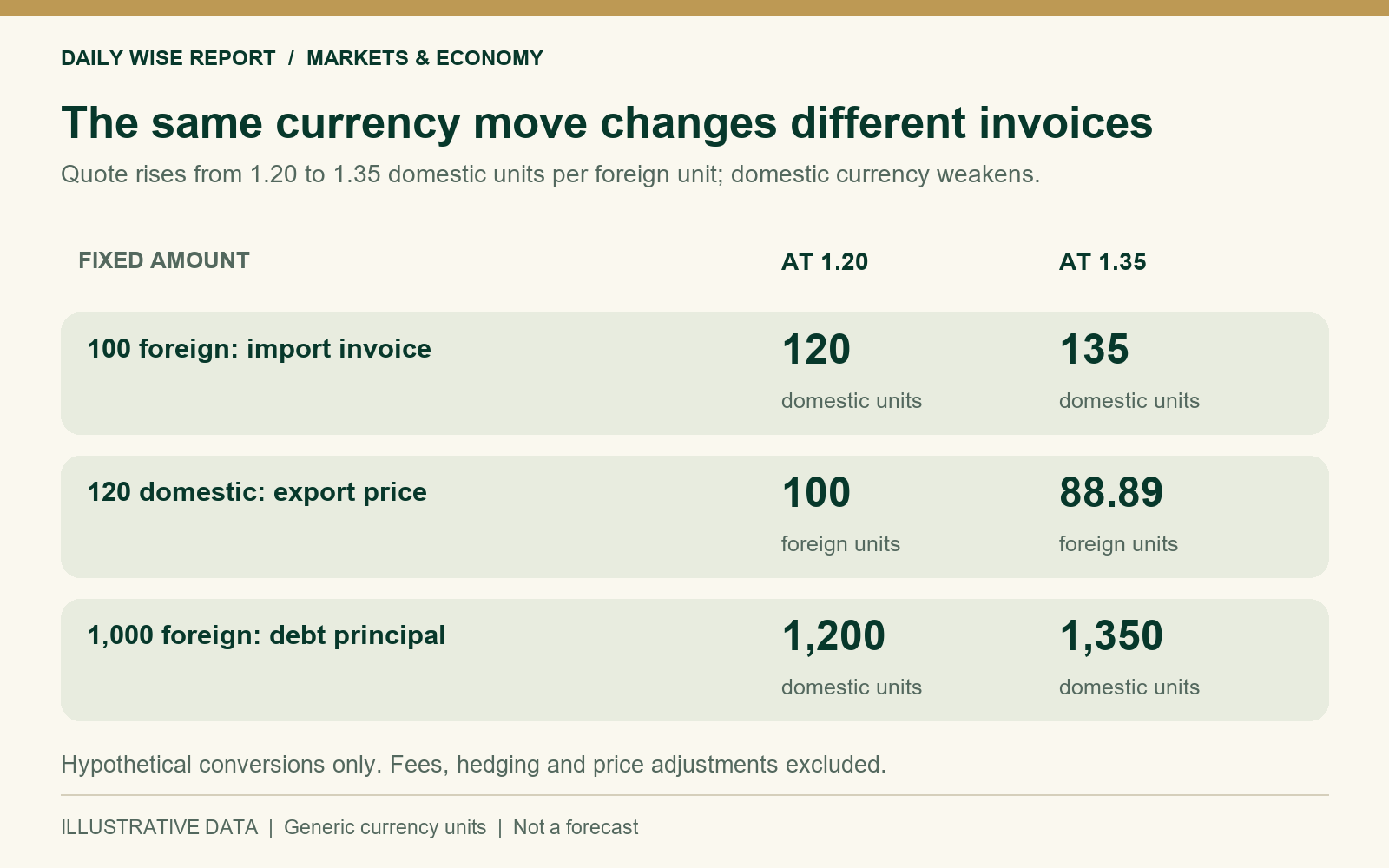
In our imaginary example, one foreign currency unit costs 1.20 domestic units initially and 1.35 later. The domestic currency has weakened against the foreign currency under this quote. No real currency pair or current market rate is used.
| Item held fixed | At 1.20 domestic per foreign | At 1.35 domestic per foreign |
|---|---|---|
| 100-unit foreign import invoice | 120 domestic | 135 domestic |
| 120-unit domestic export price | 100 foreign | 88.89 foreign |
| 1,000-unit foreign debt principal | 1,200 domestic | 1,350 domestic |
The importer faces a larger conversion bill
Converting the unchanged foreign invoice now costs 15 more domestic units, a 12.5% increase over 120. The foreign seller’s price stays fixed; the assumed exchange rate accounts for the entire increase.
A domestic retailer might absorb some of that increase, change its margin or adjust prices later. Inventory purchased earlier and hedged contracts can also delay exposure. The conversion is exact within the example; the retail response is not determined by it.
The exporter has another pricing choice
If an export remains priced at 120 domestic units, the foreign buyer’s converted price falls from 100 to about 88.89. That is a decline of approximately 11.11%, rather than 12.5%, because the reciprocal calculation uses a different starting base.
Sales and profit remain uncertain. If a separate export contract instead fixes the price at 100 foreign units, domestic revenue rises from 120 to 135 while the buyer pays the same amount. Imported inputs or foreign debt could absorb part of the revenue gain.
Debt can change without new borrowing
The foreign debt principal stays at 1,000, while its domestic equivalent rises by 150. Paying off the same foreign obligation now requires more domestic currency, without any new borrowing.
Matching foreign income, hedging or a different repayment date could alter the actual exposure. A translated debt value is not necessarily a cash loss realized that day.
Scope and limitations
All currencies and figures are hypothetical. Contract currency, exchange-rate regimes, fees and timing vary. The example neither predicts currency movements nor recommends a trade, hedge or borrowing decision.
Related reading
Why a Central Bank Rate Change Reaches People at Different Times
Leave a Reply