Why Fixed-Rate Bond Prices Can Fall When Market Yields Rise
An unchanged future payment can have a different price today. Discounting explains the relationship, while credit risk and timing complicate actual outcomes.
Buyers pay less today for a fixed future bond payment when they require a higher return. The promised payment can stay unchanged throughout that price decline.
Hold the future payment constant
Investor.gov’s interest-rate-risk bulletin explains the general inverse relationship between market rates and fixed-rate bond prices. It also notes that maturity and coupon characteristics influence sensitivity. This is a mechanism, not a prediction that every bond will move identically.
Our model has only one remaining payment: 1,050 currency units exactly one year from now, comprising 1,000 principal and a 50-unit coupon. There are no earlier payments. Assume full payment is certain and ignore fees and tax.
| Required one-year yield | Calculated price today | Payment in one year |
|---|---|---|
| 3% | 1,019.42 | 1,050 |
| 5% | 1,000.00 | 1,050 |
| 7% | 981.31 | 1,050 |
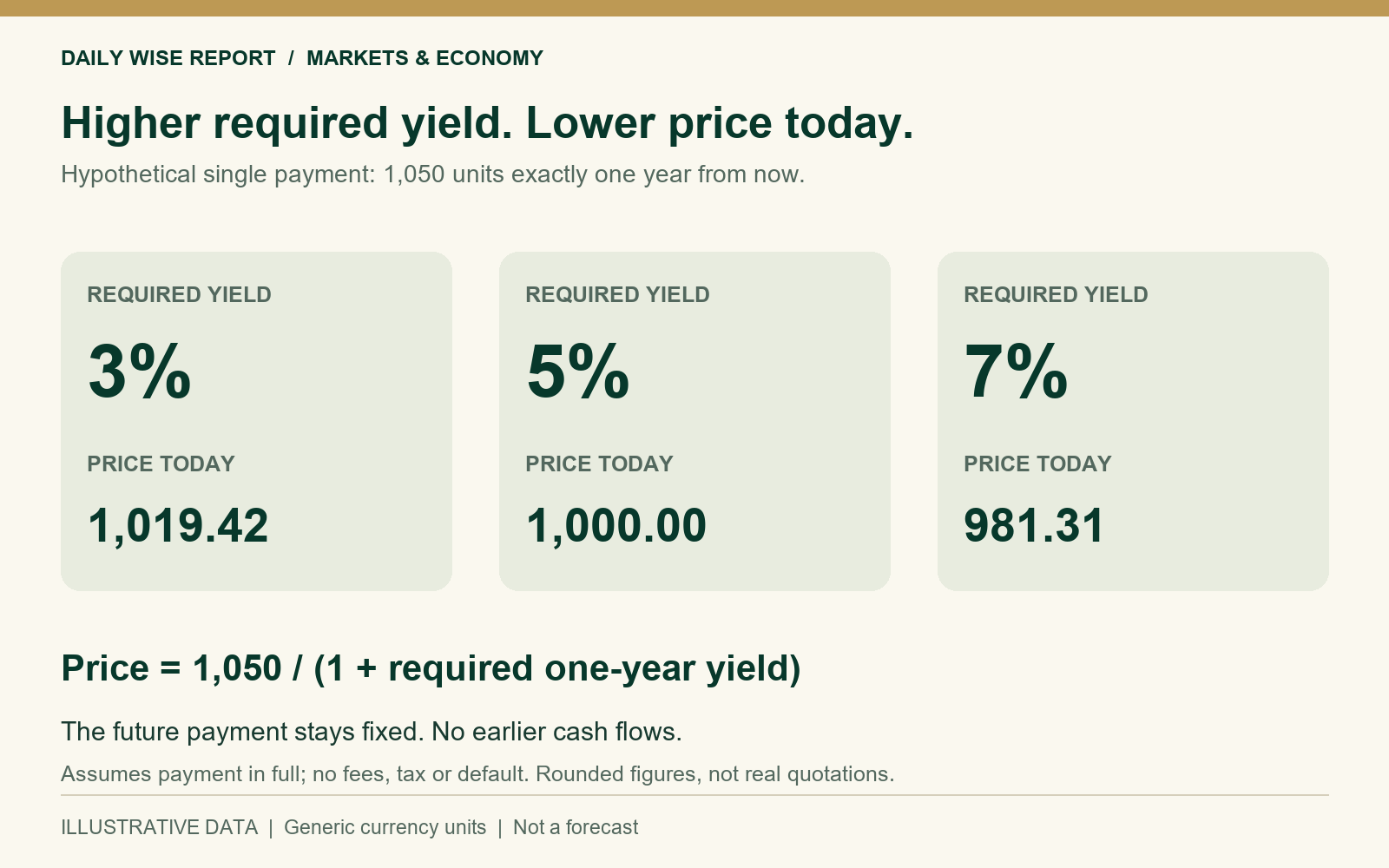
Receiving 1,050 after one year gives a 5% return on a price of 1,000. Paying less for that unchanged payment gives a higher return under the same assumptions.
Coupon, purchase price and yield
The 50-unit coupon is 5% of the 1,000-unit principal. At a price of 981.31, however, dividing the coupon by the purchase price gives roughly 5.10%. That current-yield-style ratio omits the gain from buying below the principal repayment amount.
In the model, the full return also includes that price-to-redemption difference. Actual multi-period yield calculations must account for all cash-flow dates. A coupon percentage cannot substitute for the entire calculation.
Sale timing and credit risk add uncertainty
An owner who paid 1,000 and later sold for 981.31 would receive 18.69 less than the purchase price, before any intervening income or costs. That hypothetical sale result is different from holding until the scheduled payment.
Holding does not eliminate every risk. The assumption of certain payment may fail for a real issuer, and inflation can reduce the purchasing power of the proceeds. A separate Investor.gov corporate-bond explanation discusses default and liquidity risks. A change in creditworthiness can move the price even when a benchmark rate is unchanged.
Scope and limitations
This one-payment example excludes default, accrued interest, options and changing cash flows. It does not describe a bond fund, calculate a real quotation or recommend buying, selling or holding bonds.
Related reading
Why a Central Bank Rate Change Reaches People at Different Times
Leave a Reply