Markets & Economy
The forces behind prices, growth, interest rates, and currencies.
Markets & Economy, in depth.
 Analysis
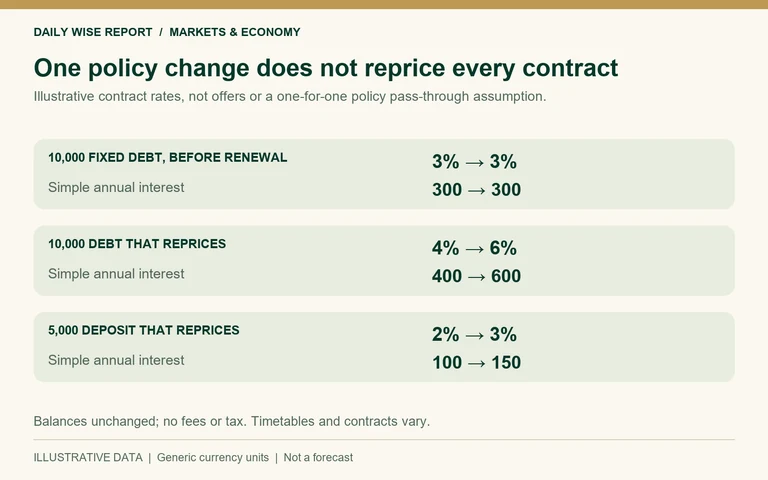
Why a Central Bank Rate Change Reaches People at Different Times
Policy rates, market rates and the rates on existing contracts do not move together automatically. Repricing dates and contract design shape the transmission.
Read full article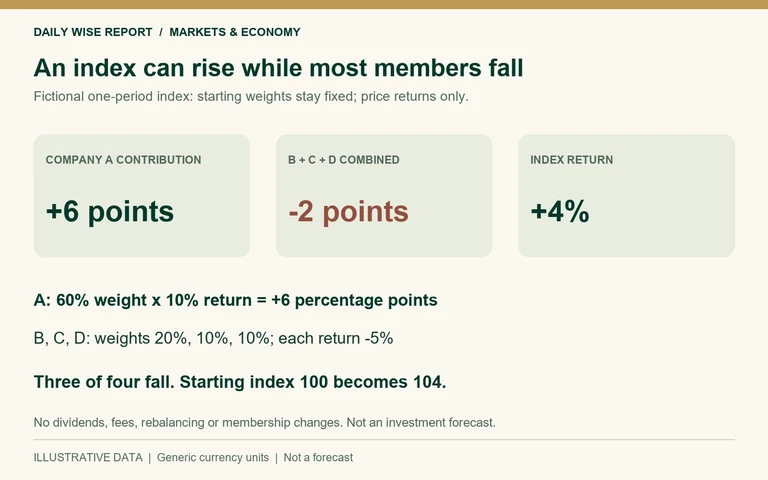 Analysis
Why a Stock Index Can Rise While Most of Its Members Fall
The number of rising companies and their weights are different measurements. A few large constituents can dominate a weighted index’s result.
Read full article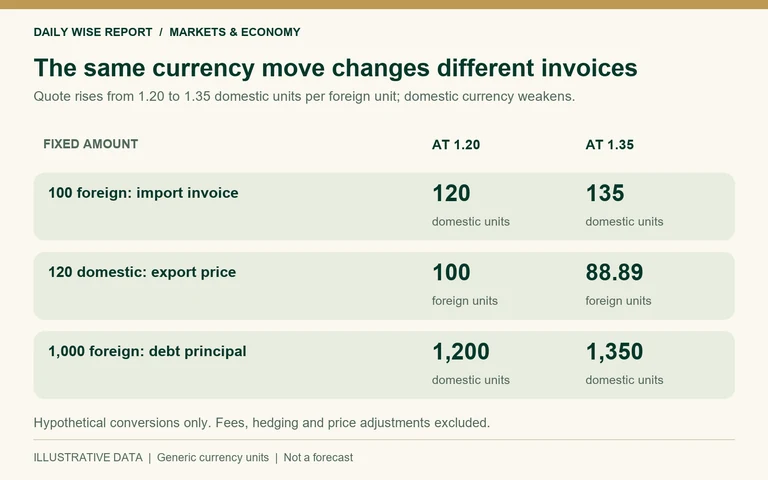 Analysis
A Weaker Currency Creates Different Costs for Importers and Exporters
The direction of an exchange-rate quote matters. Foreign invoices, export prices and foreign-currency debts can respond differently to the same movement.
Read full article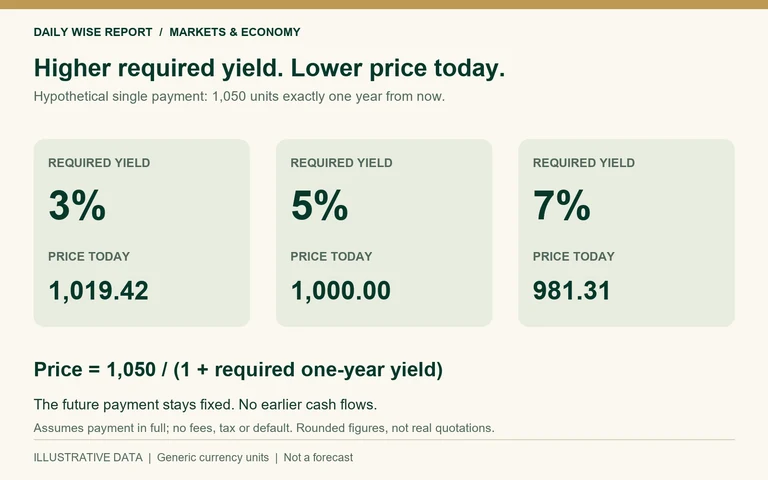 Analysis
Why Fixed-Rate Bond Prices Can Fall When Market Yields Rise
An unchanged future payment can have a different price today. Discounting explains the relationship, while credit risk and timing complicate actual outcomes.
Read full article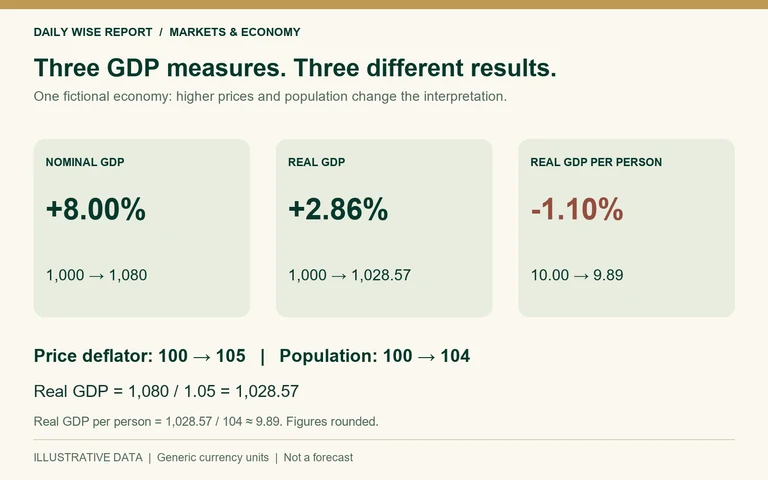 Analysis
GDP Growth Can Look Stronger Than the Economy Feels
Nominal output, inflation-adjusted output and output per person answer different questions. None directly measures every household’s living standard.
Read full article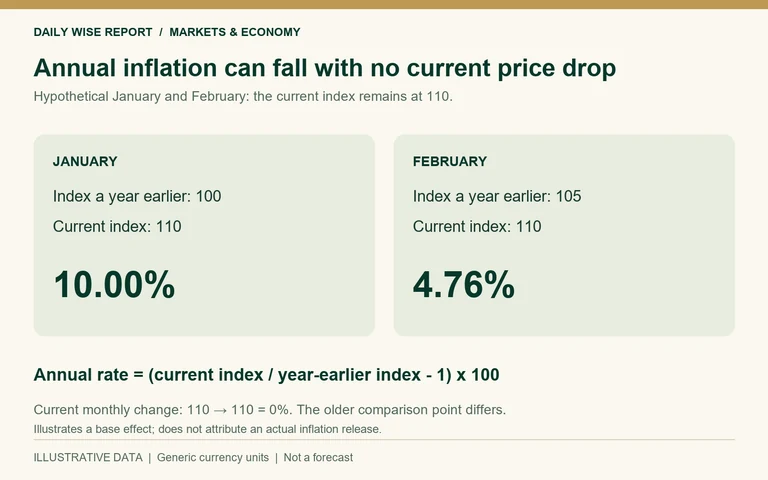 Analysis
How Inflation Can Fall While Prices Stay High
An annual inflation rate compares two price levels. A change in the older comparison point can alter the rate even when today’s prices barely move.
Read full article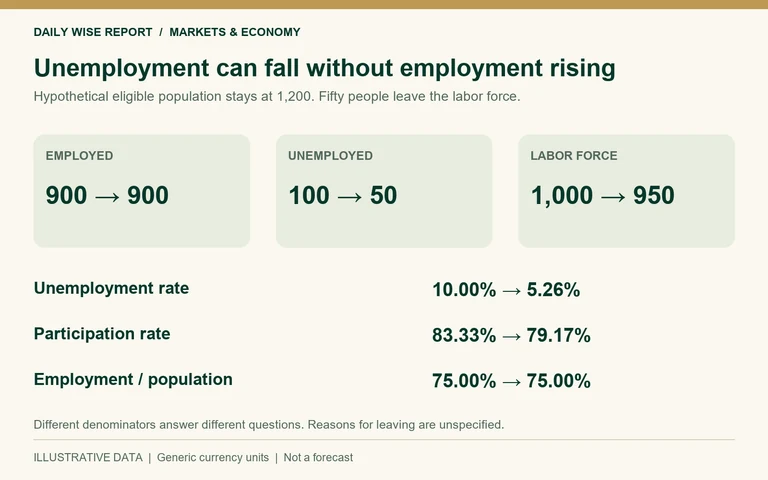 Analysis
A Falling Unemployment Rate Does Not Always Mean More People Have Jobs
The labor force is the denominator. Changes in participation can lower the unemployment rate even when the number employed stays unchanged.
Read full articleEconomic changes. Uneven effects.
Understand how market and economic mechanisms work, why outcomes differ, and where negative effects can emerge.
Market Prices & Expectations
Why prices respond to changing information.
Explore concept ↓02GDP & Economic Growth
What output measures—and what it leaves out.
Explore concept ↓03Interest Rates & the Economy
How policy changes reach households and businesses.
Explore concept ↓04Exchange Rates
Why the same movement has different consequences.
Explore concept ↓Market Prices & Expectations
Prices in traded markets reflect transactions between buyers and sellers. New information can alter their expectations about earnings, costs, interest rates, or risk. Different participants may interpret the same information differently.
How it works
A hypothetical business may report higher sales while its share price falls if participants expected an even larger increase. The direction of a price change cannot be inferred from a headline alone.
Negative effects & limitations
Price changes can produce losses and uncertainty. A short-term move does not prove that an asset is fairly valued or reveal a single cause. Market conditions and trading arrangements also affect how prices adjust.
GDP & Economic Growth
Gross Domestic Product measures the value of final goods and services produced within an economy during a period. Real GDP adjusts for price changes; nominal GDP does not.
How it works
Nominal output can rise because of higher prices, greater production, or both. Real growth is therefore different from an increase in the money value of output.
Negative effects & limitations
Aggregate growth does not show how income is distributed. GDP is not a complete measure of well-being: it does not fully capture unpaid household work, environmental damage, or differences in living conditions.
Interest Rates & the Economy
Central-bank policy rates can influence lending rates, deposit rates, spending, and financial conditions. The transmission is indirect and differs across economies and contracts.
How it works
Higher borrowing costs can reduce demand for credit and spending. Existing fixed-rate borrowers may feel a change only when refinancing or when their fixed period ends; variable-rate contracts can respond sooner.
Negative effects & limitations
Higher rates can increase debt burdens and weaken investment or employment. Savers may receive more interest, but the pass-through is not uniform. Effects occur with delays and depend on the wider economy.
Exchange Rates
An exchange rate expresses the price of one currency in another. Floating rates change with market conditions; fixed or managed systems operate differently.
How it works
If one unit of currency A buys fewer units of currency B, A has weakened relative to B. Imports priced in B may become more expensive in A, though contracts, margins, and other costs affect the final price.
Negative effects & limitations
Currency movements can raise import costs or increase the local-currency burden of foreign-currency debt. They can also affect export competitiveness. Outcomes depend on invoicing, hedging, and production costs; a stronger currency is not universally beneficial.
Sources & scope
These explanations concern general mechanisms, not current market conditions or forecasts. Hypothetical scenarios illustrate possibilities and do not establish the cause of any observed market movement.
IMF materials provide economic context. Bank of England explanations describe UK institutions and transmission channels; policy frameworks and exchange-rate regimes differ internationally. Investor.gov is a US investor-education source, not a statement of global legal rules.
Reviewed October 14, 2026. No asset rankings, price targets, or personalized investment recommendations are provided.
Mechanisms
Separate what an indicator measures from how it is interpreted.
Consequences
Explore different effects on households, businesses, and borrowers.
Uncertainty
Identify assumptions, time lags, and alternative explanations.